


An Irish Builder of the Technocratic Gulag

According to journalist and author Iain Davis, the infrastructure for the Digital Gulag and the One World Government plan of the technocrats is already built. Peter Thiel, the Paypal tech billionaire, is one of the Silicon Valley tech-bros who are helping to build the gulag. Davis argues that Thiel’s influence extends beyond just software design into the shaping of a Technate, a merger between state and corporate power under the guidance of technological elites rather than democratic institutions. The merging of state and corporate power is the very definition of fascism. In Davis’s analysis, Thiel’s backing of figures, networks, and technologies linked to surveillance, artificial intelligence, digital identity systems, and technocratic governance reflects a broader ideological commitment to rule by technically proficient oligarchs. Davis frequently connects Thiel with thinkers such as Curtis Yarvin and with a Silicon Valley view that liberal democracy is inefficient and obsolete and needs to be replaced with hierarchical, data-driven management systems run by corporate-technological actors.1
Peter Thiel and Declan Ganley, who are both deeply involved with this project, represent a convergence of Christian-inflected political conservatism, advanced digital technology entrepreneurship, and close alignment with Western defense and intelligence interests. Thiel, a prominent ‘libertarian’ Christian investor associated with Palantir and other surveillance and data-analysis ventures, has long advocated for technologically driven governance and has cultivated deep ties with U.S. military and intelligence agencies through companies serving the Pentagon and national security apparatus. Ganley, meanwhile, is the founder and CEO of Rivada Networks, a U.S.-based communications company with defense and government connections which is built around secure telecommunications systems for military and government use, including contracts and partnerships linked to the U.S. Department of Homeland Security and defense-related spectrum initiatives. In 2023 Mike Pompeo, former CIA Director (2017-2018), joined the advisory board of Rivada Space Networks, a wholly owned subsidiary of Rivada Networks. Both Thiel and Ganley frame their politics partly in civilizational and Christian terms, particularly in opposition to secular liberal globalism, while emphasizing sovereignty, security, and technological control of communications infrastructure. Their relationship is also financial: Thiel has been a significant financial backer of Ganley’s Rivada Networks and its satellite ventures with multiple reports identifying him as an investor in Ganley’s projects.2 In addition Ganley is reported to own less than 50% of Rivada Networks suggesting he’s not the one pulling the strings.3
In 2023 Mike Pompeo, former CIA Director (2017-2018),
joined the advisory board of Rivada Space Networks,
a wholly owned subsidiary of Rivada Networks.
During the final year of Donald Trump’s first presidency in 2020, Rivada Networks became the center of a major Washington controversy over a proposed Department of Defense 5G spectrum initiative. Rivada and its political allies advocated a plan under which valuable mid-band Pentagon spectrum would be leased into a wholesale shared-access network rather than auctioned directly to telecom carriers. Opponents of the deal — including major telecom companies, FCC officials, and some Pentagon leaders — alleged the White House was pressuring the DoD to structure the deal in a way that would effectively favor Rivada without a normal competitive process. Reporting by CNN and The New Yorker described lobbying efforts involving prominent Republican figures such as Karl Rove and Newt Gingrich, while Rivada investor Peter Thiel was also noted because of his financial support of both Trump and J.D. Vance for Trump’s first term in office.4 Rivada denied seeking a “nationalized 5G network” or preferential treatment, arguing instead that its spectrum-sharing model would accelerate U.S. competitiveness against China and Huawei. It also has a case against CNN going though the Irish courts currently based on this report.5 Ultimately the proposal stalled amid resistance from the Pentagon, telecom industry, and FCC, but the episode cemented Rivada’s reputation as a politically connected strategic communications company operating at the intersection of telecom policy, national security, and Republican power networks.
CNN report from 2020 covering the White House/Rivada controversy.
Another controversial aspect of Peter Thiel’s influence and his company Palantir Technologies activities has been its growing role in military surveillance and AI-assisted warfare, particularly in relation to Israel’s operations in Gaza. In January 2024, Palantir entered into a strategic partnership with the Israeli Ministry of Defense to provide advanced battlefield and artificial intelligence technologies to support the IDF during the Gaza genocide.6 Human rights advocates have argued that Palantir’s data integration and targeting capabilities contribute to increasingly automated forms of warfare in which AI systems help identify and prioritize targets for airstrikes, raising concerns about civilian casualties and the erosion of meaningful human oversight in lethal decision-making. The company has also faced controversy for its work with U.S. intelligence agencies, predictive policing programs, and Immigration and Customs Enforcement (ICE), leading opponents to describe Palantir as a central pillar of the emerging surveillance-security state.
The strategic alignment between Palantir and Rivada lies in their shared commitment to building the technological infrastructure of modern military and intelligence operations for the technocrats panopticon or digital gulag. While Palantir specializes in battlefield data integration, surveillance analytics, and AI-assisted targeting systems for defense agencies, Rivada focuses on creating secure, resilient communications networks designed for military and government use. Both companies position themselves not merely as commercial technology firms but as integral partners of the new national security state which is envisioned. This alignment is clearly reflected in the words of Michael Abad-Santos, CEO of Rivada Select Services a wholly owned subsidiary of Rivada Networks, who states: “What I am worried about and what I think about on a daily basis is how can I best support the war fighter? So how can I best support the Navy, the Army, the Air Force, Space Force, Coast Guard, Marine Corps. How can what we do here help them, you know, do their jobs more effectively, more securely and more safely.” The emphasis on secure communications, operational efficiency, and integrated digital warfare closely parallels Palantir’s own mission of enhancing military decision-making through advanced software, AI, and real-time intelligence analysis, illustrating how both firms contribute to the expanding fusion of Silicon Valley technology with Western defense and security infrastructures. In other words putting the finishing touches to the infrastructure of the technocratic superstate.
Michael Abad-Santos, CEO of Rivada Select Services
a wholly owned subsidiary of Rivada Networks
Opponents of technocracy argue that companies such as Palantir and Rivada increasingly treat active war zones as real-world testing grounds in which new forms of digital warfare infrastructure can be refined under battlefield conditions. In Ukraine, Palantir has supplied the Ukrainian military with AI-enabled data integration, targeting, and battlefield analysis platforms capable of processing satellite imagery, drone feeds, intelligence reports, and troop movements in real time, effectively turning the conflict into a proving ground for algorithmic warfare and network-centric combat systems.7 Similarly, Gaza has become emblematic of the growing integration of advanced surveillance, communications, and AI-assisted targeting technologies into modern military operations, with Palantir reportedly expanding cooperation with the Israeli defense establishment during the war.8 Rivada’s emphasis on highly secure, resilient communications networks for military and government use aligns with this broader transformation, as modern warfare increasingly depends not only on weapons themselves but on the seamless integration of satellites, data platforms, artificial intelligence, Data Centers, and encrypted battlefield communications. In this sense, conflicts such as Ukraine and Gaza function not only as geopolitical flashpoints but also as laboratories for the next generation of technologically integrated warfare systems being developed by private defense-tech corporations in partnership with states and military alliances.

Peter Goldscheider who sits on the board of Rivada Networks.
Rivada Networks’ connections to Ukraine can also be seen through the activities of Austrian financier Peter Goldscheider, who serves on Rivada’s board while simultaneously maintaining extensive business and telecommunications interests in The Ukraine. Goldscheider was President of KINTO Investments & Securities in Kyiv and later became Chairman of the Supervisory Board of Ukrtelecom, Ukraine’s largest fixed-line telecommunications provider and one of the country’s oldest telecom operators, after EPIC, the Vienna-based investment group he co-founded, acquired a controlling stake in the Ukrainian telecom giant through its subsidiary ESU Ltd. His involvement placed him at the intersection of Eastern European privatization, telecommunications infrastructure, and geopolitical influence networks surrounding Ukraine’s post-Soviet economic transformation. Critics have pointed to these overlapping roles as evidence of how figures connected to Rivada participated in the strategic restructuring of Ukraine’s communications sector, a domain that has become increasingly important in the context of cyberwarfare, intelligence operations, and NATO-aligned digital infrastructure. Goldscheider’s simultaneous association with Rivada and Ukrtelecom therefore illustrates how private telecommunications and defense-oriented technology interests intersected with Ukraine’s evolving strategic importance long before the current war.
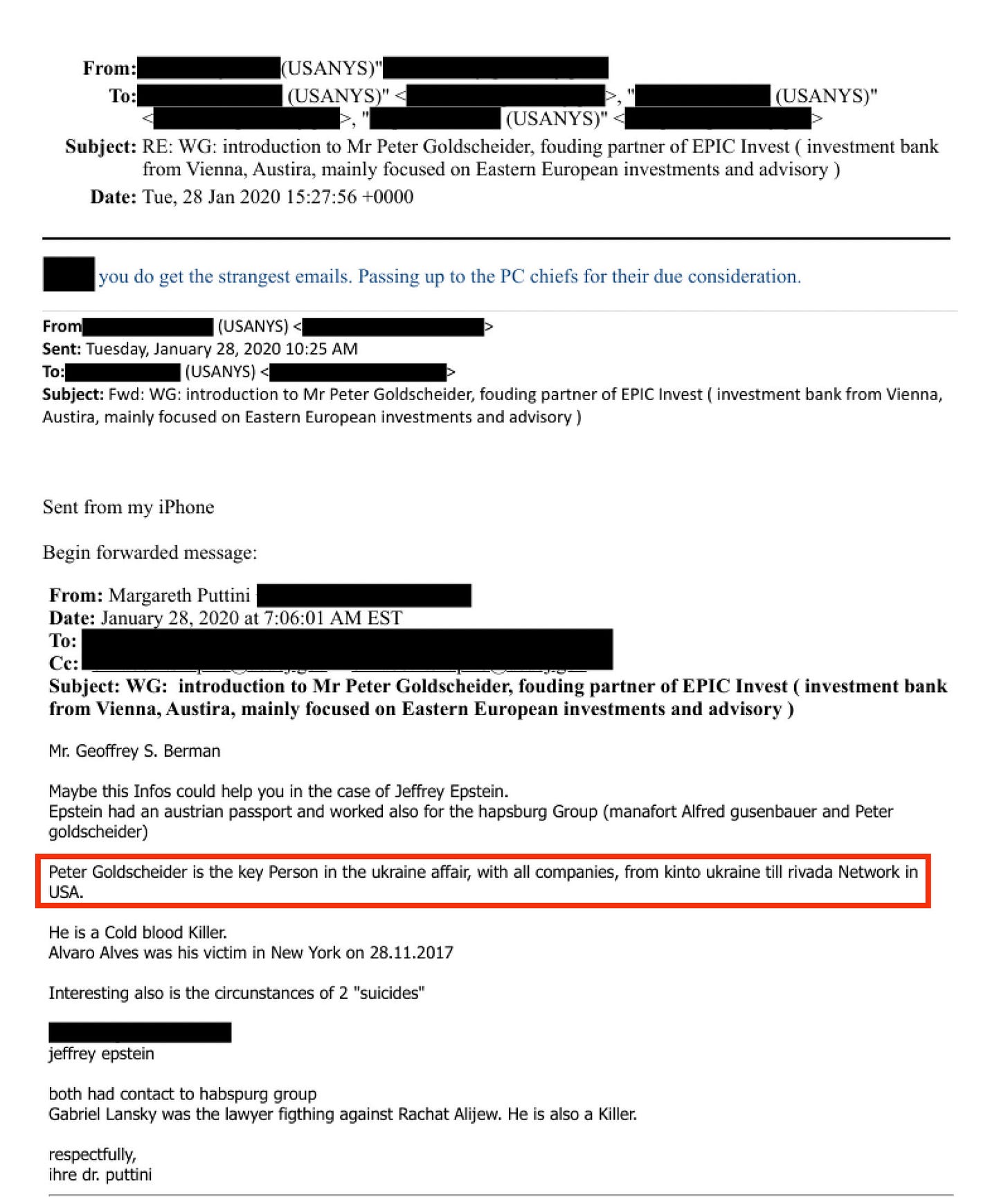
Ref: EFTA00016805. Detail from Epstein file featuring Rivada and Goldscheider.
Unwelcome to Rivada, perhaps, is also mention of both Goldscheider and Rivada in one of the Epstein files released by the Department of Justice in the U.S.. It reads “Peter Goldscheider is the key person in the Ukraine affair, with all companies, from Kinto Ukraine till Rivada Network in USA”. It appears to frame Goldscheider as a central intermediary linking Ukrainian financial and telecommunications interests with Western technology and defense-oriented corporations like Rivada Networks. The statement likely refers to Goldscheider’s overlapping roles in KINTO, the Kyiv-based investment group, his involvement with EPIC and Ukrtelecom during the controversial privatization of Ukraine’s telecommunications infrastructure, and his later position on the board of Rivada Networks. Read in context, the claim suggests that Goldscheider functioned as a transnational connector between post-Soviet privatization networks, strategic telecom assets in Ukraine, and emerging Western military-communications enterprises.
The next sentence describes Goldscheider as a “cold blood killer“ which, on the face of it, is a clearly defamatory statement for which no evidence is presented and the author of the email, “dr puttini“ remains unidentified. With such a serious accusation out in the public domain with no evidence provided to back it up it remains unclear why the Department of Justice in the U.S. have chosen to publish this email on their website where it currently remains. Also, to date, there is no indication that Goldscheider has denied the allegation against him or requested the Department of Justice to have the document removed. In addition Rivada Networks has also made no comment on this serious allegation concerning one of its directors and remain strangely silent on the issue.
It points to one of the strange paradoxes present with both Thiel and Ganley and that is that they are both practising Christians, a religion which preaches a gospel of love, yet both are deeply involved within military and intelligence circles and are actively involved in the building of the technocratic gulag infrastructure which, if successful, will totally enslave humankind. The digital ID and programmable money envisaged in this architecture will control where we spend money, how much we spend, what we spend it on etc. In other words they are implementing a global control system in which we will all be behaviorally controlled. It is unclear how Thiel and Ganley square a gospel of love with the infrastructure of enslavement they are both building.
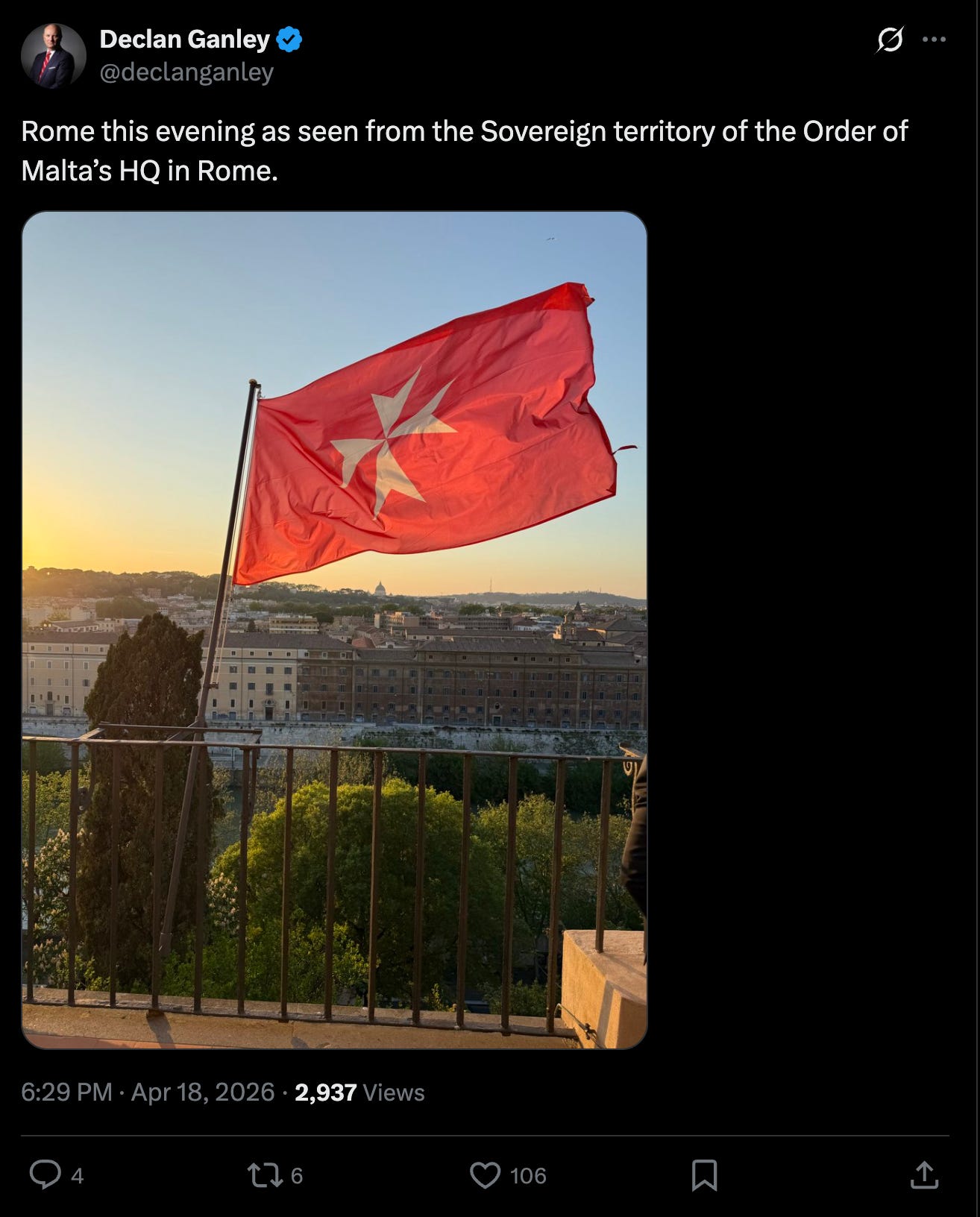
Picture posted on Declan Ganley’s X-feed of view from Order of Malta HQ in Rome.
On April 18 Ganley tweeted a picture from within one of the two Rome headquarters of the Order of Malta, a Catholic religious order and humanitarian organization. The Sovereign Military Order of Malta is one of the world’s oldest surviving chivalric orders, tracing its origins to the medieval Knights Hospitaller, the crusader-era religious order founded in Jerusalem in the 11th century to care for pilgrims before evolving into a powerful military force alongside the better-known Knights Templar. The Order is a sovereign subject of international law with diplomatic relations with more than 100 states and enjoys UN observer status. It issues its own passports, maintains embassies and enjoys diplomatic immunity. Historically the Order has attracted aristocrats, diplomats, military officers, financiers and intelligence elites across Europe and the United States, including former CIA directors William J. Casey and John McCones. Ganley’s recent photographs from within the restricted Magistral Villa on Rome’s Aventine Hill therefore suggest not ordinary tourist access but some degree of special relationship within Order of Malta circles. It highlights yet again the connection Ganley has built up in military and CIA intelligence circles over the years.
These same elites are now doubling down and pushing through the digital gulag architecture everywhere. In this short clip John Titus asks technocracy researcher Iain Davis ‘how close are we to the digital gulag?’
Iain Davis interviewed by John Titus on the Solari Report website.
Critics of expanding digital identity systems and centralized online governance argue that powerful technology investors and political figures — including people such as Peter Thiel and Declan Ganley — envision a future in which access to banking, communication, travel, and even public discourse becomes increasingly conditional on participation in tightly monitored digital systems. Supporters describe these developments as necessary for security and efficiency, while people are increasingly experiencing the creeping surveillance, social control, and the erosion of personal autonomy — a “digital gulag” built not with barbed wire, but with algorithms, compliance scores, and dependency. Despite the immense financial and political pressure behind such initiatives, resistance has grown steadily as more and more people across the political spectrum become aware of the significance of the changes envisioned by the technocrats. Once inside the digital gulag it will be very difficult to escape.