
Buffett Money, Dark Money, and the Financial Engine Behind the SEL Pipeline

By Project Milk Carton | The Constitutional Republic
In Part 1 of this investigation, we followed the organizations.
In Part 2, we uncovered the documented alignment between Second Step Social-Emotional Learning curriculum and the Southern Poverty Law Center’s Learning for Justice standards.
Now we arrive at the biggest question yet:
Who financed the system behind it all?
Because systems this large do not emerge organically.
Curriculum programs reaching tens of millions of children do not suddenly appear in classrooms nationwide without coordination.
And educational frameworks do not become embedded into public schools across America without enormous amounts of money moving behind the scenes.
Once we begin tracing the funding pipeline behind the SEL industry, an entirely different picture emerges:
A deeply interconnected network of billionaire foundations, donor-advised funds, nonprofit pass-through organizations, curriculum companies, certification systems, ideological advocacy groups, and institutional partnerships that collectively helped build one of the most influential education pipelines in modern American history.
And at the center of that network sits a foundation tied directly to one of the richest men in the world.
The NoVo Foundation.
Warren Buffett’s Billion-Dollar Education Pipeline
The NoVo Foundation was established in 2006 by Peter Buffett and Jennifer Buffett.
Peter Buffett is the youngest son of billionaire investor Warren Buffett.
The foundation launched with an extraordinary financial transfer:
350,000 shares of Berkshire Hathaway stock valued at approximately $1 billion at the time.
That instantly transformed NoVo into one of the wealthiest private foundations in America.
Today, NoVo reportedly controls approximately:
-
$937.8 million in assets
-
and has distributed roughly $3.6 billion in grants since 2014 alone
That is not ordinary philanthropy.
That is institutional-scale influence.
To understand the magnitude of this operation, consider this:
Many public school districts in America do not control budgets approaching that level of concentrated private capital.
Yet one unelected private foundation now possesses enough financial power to influence educational systems nationwide.
And according to the research, that influence was not accidental.
It was strategic.
RED FLAG: Invitation-Only Funding
One of the most important details uncovered in this investigation is how NoVo operates.
Unlike traditional charities that openly accept grant applications from the public, NoVo reportedly functions primarily through invitation-only grants.
That distinction matters enormously.
Because invitation-only funding creates a controlled ecosystem.
It allows a foundation to selectively finance organizations already aligned with its objectives while bypassing broader public scrutiny.
In practical terms, this means:
-
NoVo chooses the organizations
-
NoVo chooses the initiatives
-
NoVo chooses the ideological direction
-
and NoVo chooses which systems receive long-term institutional support
This is not grassroots educational reform.
This is top-down infrastructure building.
And one of the largest systems NoVo chose to finance was Social-Emotional Learning.
The Collaborating Districts Initiative
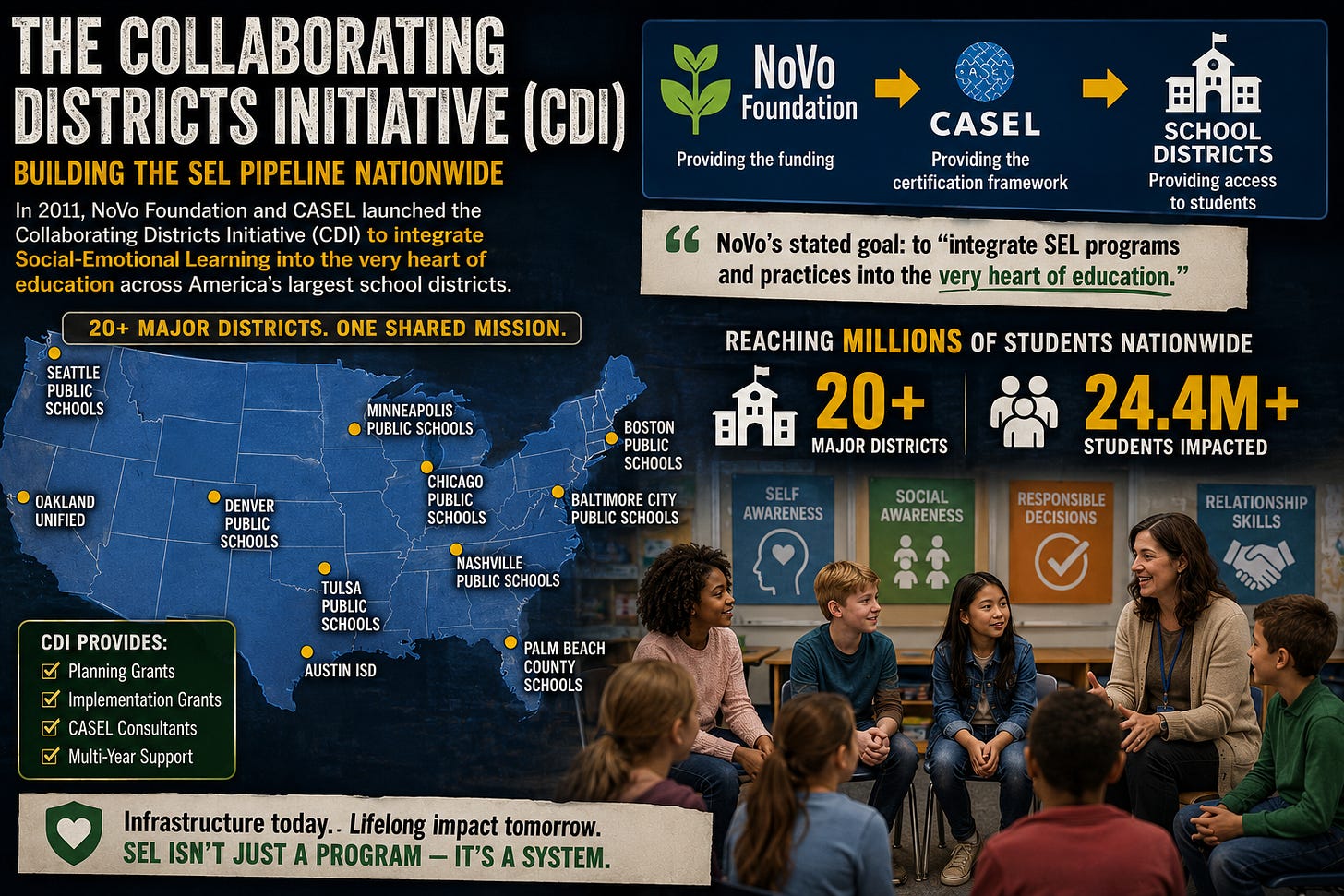
In 2011, NoVo partnered with CASEL — the Collaborative for Academic, Social, and Emotional Learning — to launch the Collaborating Districts Initiative (CDI).
This was one of the most consequential moments in the expansion of SEL nationwide.
Because this was not merely curriculum distribution.
This was systems integration.
The objective was to permanently embed SEL into the operational structure of American public education.
According to the research:
-
NoVo financed the initiative
-
CASEL created the framework
-
school districts implemented the system
-
consultants trained administrators
-
and curriculum providers aligned products to CASEL standards
This is how institutional ecosystems are built.
One organization supplies the money.
Another supplies the standards.
Another supplies the curriculum.
Another supplies the training.
And eventually the framework becomes normalized inside classrooms nationwide.
RED FLAG: “Into the Very Heart of Education”
One statement uncovered during this investigation may be the clearest admission of intent in the entire SEL funding network.
NoVo stated its goal was to:
“Integrate SEL programs and practices into the very heart of education.”
That wording matters.
Notice what was not said.
Not:
-
“offer optional emotional support”
-
“provide supplemental counseling”
-
“assist struggling students temporarily”
The stated objective was integration into the very heart of education itself.
That means SEL was never intended to remain a side program.
The goal was systemic transformation.
And systemic transformation requires long-term financial infrastructure.
That is exactly what NoVo helped build.
The Nationwide District Rollout
The Collaborating Districts Initiative reportedly expanded into more than 20 major school districts across the United States.
Districts included:
-
Chicago Public Schools
-
Austin ISD
-
Denver Public Schools
-
Baltimore City Schools
-
Oakland Unified
-
Nashville Public Schools
-
Palm Beach County Schools
-
Tulsa Public Schools
-
Boston Public Schools
-
Minneapolis Public Schools
This was not isolated experimentation.
This was nationwide deployment.
Districts reportedly received:
-
planning grants
-
implementation grants
-
CASEL consultants
-
leadership training
-
strategic planning support
-
and multi-year institutional funding
This is a critical distinction.
Temporary pilot programs do not reshape educational systems.
Long-term embedded funding does.
CASEL — The Gatekeeper of SEL
At the center of the SEL ecosystem sits CASEL.
CASEL functions as the certification authority for the entire SEL industry.
Its influence cannot be overstated.
Schools, districts, counselors, and administrators frequently rely on CASEL endorsements when selecting curriculum products.
CASEL’s highest curriculum designation is known as:
“SELect.”
That certification became the gold standard within the SEL marketplace.
And once CASEL certifies a curriculum, districts often treat that curriculum as institutionally validated.
That creates enormous influence over what enters classrooms.
RED FLAG: The Closed Certification Loop
This is where the network becomes deeply concerning.
According to the research:
-
NoVo funds CASEL
-
CASEL certifies Second Step
-
Committee for Children builds Second Step to CASEL standards
-
Committee for Children aligns Second Step with SPLC Learning for Justice standards
-
Committee for Children sponsors CASEL conferences
-
CASEL leadership publicly advocates anti-racism integration into SEL
This creates what can only be described as a self-reinforcing institutional loop.
The same organizations:
-
finance the standards
-
certify the curriculum
-
sponsor the conferences
-
train the educators
-
promote the ideology
-
and validate one another’s systems
That creates a closed ecosystem with limited outside accountability.
And once educational ecosystems become self-validating, transparency becomes extremely difficult.
The Rockefeller-Kennedy Connection
The origins of CASEL itself reveal another layer of institutional influence.
CASEL was co-founded in 1994 by:
-
Eileen Rockefeller Growald
-
Timothy Shriver of the Kennedy family
-
Daniel Goleman, author of “Emotional Intelligence”
This means SEL’s foundational leadership was connected from the beginning to some of the most powerful philanthropic and political families in America.
Additional funding and institutional support reportedly involved:
-
Gates Foundation
-
Chan Zuckerberg Initiative
-
Robert Wood Johnson Foundation
-
Rockefeller-connected philanthropy
-
Chicago Community Trust
Again, the issue is not merely that wealthy individuals support causes.
The issue is concentration of influence.
Because once billionaire-connected foundations begin financing:
-
curriculum systems
-
teacher training
-
counselor standards
-
educational frameworks
-
and district implementation
they begin shaping public education itself.
Without voters ever approving it.
RED FLAG: The 2020 Anti-Racism Pivot
In 2020, CASEL publicly shifted its framework following the nationwide unrest after George Floyd’s death.
CASEL leadership declared:
“Social-emotional learning must actively contribute to anti-racism.”
That statement represented a major ideological shift.
SEL was no longer being framed simply as:
-
emotional wellness
-
empathy
-
behavioral support
-
or conflict resolution
It was now openly connected to anti-racism and social justice activism.
That matters because CASEL-certified curriculum products — including Second Step — were already aligned with SPLC Learning for Justice standards.
This reveals a direct ideological pipeline:
CASEL standards → SEL curriculum → SPLC-aligned frameworks → classroom implementation.
For many parents, this is where concerns intensified dramatically.
Because emotional learning had now become intertwined with political and ideological frameworks.
Committee for Children — The Curriculum Machine
Now we arrive at the organization distributing the curriculum itself:
Committee for Children.
According to the research:
-
Committee for Children generates roughly $35 million annually
-
approximately 98% of revenue comes directly from curriculum sales
-
its programs operate in more than 32,000 schools
-
and reportedly reach 24.4 million children worldwide
This is not a small nonprofit charity.
This is a massive curriculum enterprise operating under nonprofit status.
Its flagship product is:
Second Step.
And because Second Step carries CASEL certification, districts often adopt it under the assumption that it represents institutionally approved best practice.
RED FLAG: Financial Collapse Signals
One of the most alarming findings uncovered during this investigation involves Committee for Children’s financial trajectory.
According to the financial data examined:
-
net assets reportedly fell from positive $21 million in 2019
-
to negative $9.3 million by 2025
That is an extraordinary collapse.
Additional warning signs reportedly include:
-
three consecutive years of losses
-
reserve depletion
-
declining financial stability
-
and possible over-expansion tied to SEL infrastructure growth
Why does this matter?
Because it may indicate growing resistance to SEL implementation nationwide.
If districts begin reducing purchases, delaying renewals, or facing public pressure from parents demanding transparency, organizations financially dependent on SEL adoption could face serious instability.
That creates pressure to push even harder for institutional embedding before public scrutiny expands further.
The Alignment Document
In Part 2, we examined the official alignment document connecting Second Step directly to SPLC Learning for Justice standards.
That alignment becomes even more significant once the funding network is understood.
Because now we can clearly see:
-
the same foundations financing the standards bodies
-
the same organizations certifying the curriculum
-
the same ideological frameworks embedded into lessons
-
and the same nonprofit systems reinforcing one another financially
This was not random overlap.
This was coordinated institutional alignment.
Enter the Tides Foundation
Now we arrive at one of the most controversial entities in the entire network:
The Tides Foundation.
According to the financial records examined:
-
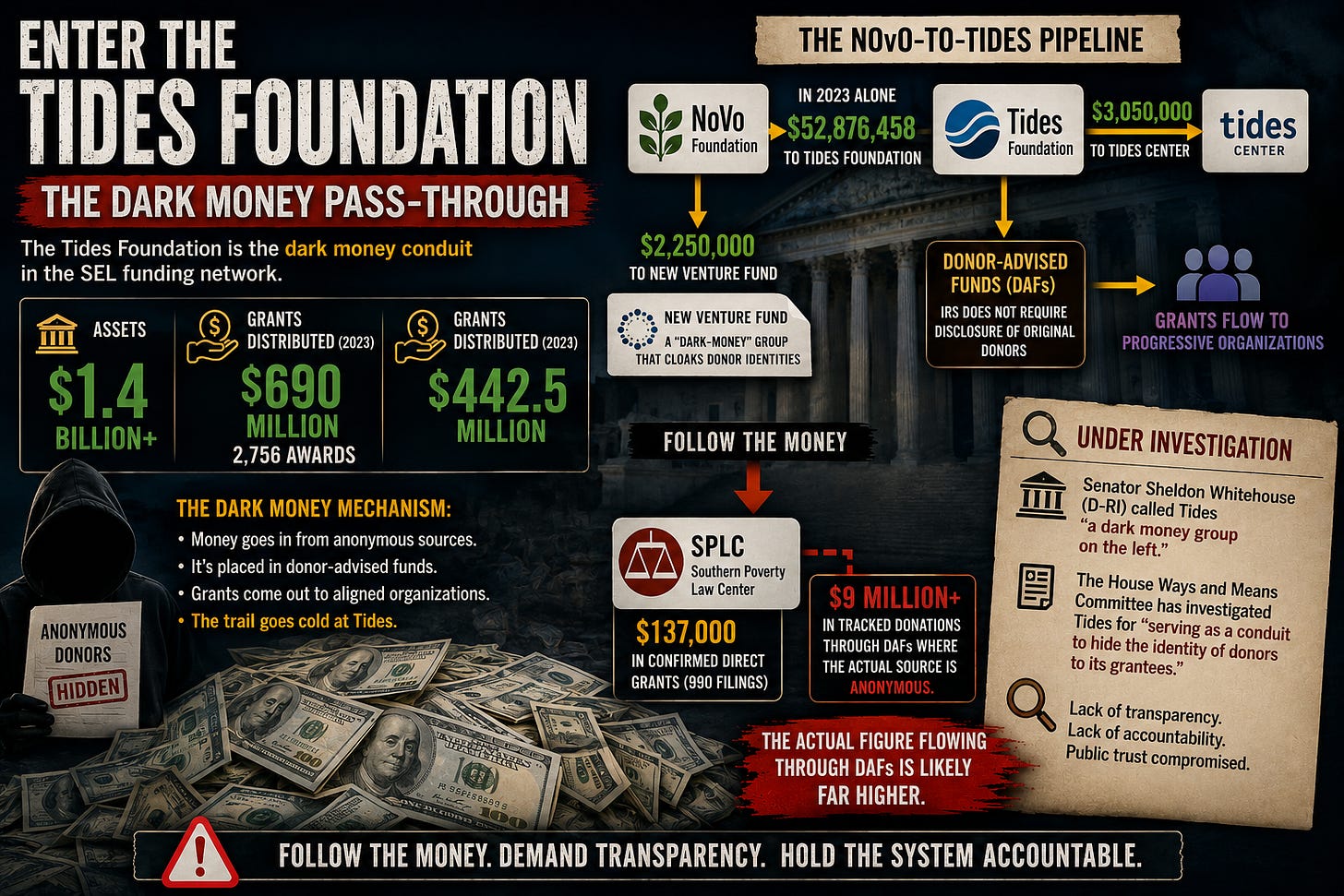
Tides controls more than $1.4 billion in assets
-
distributed approximately $690 million in grants during 2023
-
and another $442 million during 2024
That is enormous financial power.
But the controversy surrounding Tides is not simply about the amount of money.
It is about how the money moves.
RED FLAG: The Dark Money Structure
Tides reportedly operates one of the largest donor-advised fund systems on the political left.
A donor-advised fund allows wealthy donors to:
-
place money into charitable accounts
-
receive tax advantages
-
and distribute grants later through intermediary organizations
But here is the critical issue:
The public often cannot identify the original donor behind the grants.
That means:
-
money enters anonymously
-
grants emerge publicly
-
but the original funding source may remain hidden
Critics refer to this structure as “dark money.”
Supporters argue donor privacy is legal and legitimate.
But regardless of political perspective, the result is the same:
Transparency becomes dramatically reduced.
And when educational systems are influenced through opaque funding structures, public oversight weakens.
RED FLAG: The $52 Million Transfer
Financial records reportedly show:
-
NoVo Foundation transferred more than $52.8 million to Tides Foundation in 2023 alone
-
plus another $3 million to the Tides Center
That is not routine charitable giving.
That is strategic capital movement on a massive scale.
Additional findings indicate:
-
NoVo shifted entire initiatives into Tides-managed structures
-
including the “Advancing Girls Fund”
This suggests institutional layering designed to route money through multiple nonprofit channels.
And once money moves through layered nonprofit systems, tracing influence becomes significantly harder.
Congress Starts Asking Questions
The Tides Foundation has already attracted congressional scrutiny.
Investigators reportedly examined whether Tides functioned as a conduit capable of obscuring donor identities.
Concerns centered on whether donor-advised fund structures were being used to shield the origins of politically influential funding streams.
Even Senator Sheldon Whitehouse reportedly acknowledged broader concerns surrounding hidden political money flows.
Again, the issue is not necessarily criminality.
The issue is visibility.
Because democratic societies depend on transparency when powerful institutions influence public systems.
Especially education.
The Arabella Network
The investigation also uncovered connections to another enormous nonprofit influence structure:
Arabella Advisors.
According to financial records examined:
-
Arabella-linked nonprofits reportedly handled approximately $5 billion in revenues between 2019 and 2022
Major donors reportedly included:
-
Gates Foundation
-
George Soros Open Society Foundations
-
Chan Zuckerberg Initiative
Additional findings suggest:
-
roughly $2 billion in Arabella-related funding sources remain difficult to trace through donor structures
Again, this does not automatically imply illegal conduct.
But it demonstrates how massive modern nonprofit influence systems have become.
And how difficult they can be for ordinary citizens to follow.
RED FLAG: The SPLC Funding Structure
Then we arrive back at the Southern Poverty Law Center itself.
According to the financial data examined:
-
SPLC reportedly controls approximately $787 million in net assets
But perhaps more concerning:
-
more than 80% of tracked SPLC grant funding reportedly flows through donor-advised funds where original donors remain anonymous
That means the public often cannot determine:
-
who financed SPLC initiatives
-
who funded Learning for Justice
-
or who helped support standards now embedded into educational systems
That lack of transparency becomes even more significant given the legal controversies surrounding SPLC.
The research references:
-
federal fraud allegations
-
money laundering conspiracy accusations
-
and ongoing DOJ-related investigative scrutiny
Whether those allegations ultimately succeed or fail legally, the existence of such scrutiny raises serious questions about institutional accountability.
Especially when educational influence is involved.
The Self-Reinforcing Influence Machine
At this point, the overall structure becomes unmistakable.
Money enters through billionaire philanthropy.
NoVo finances CASEL.
CASEL certifies Second Step.
Committee for Children aligns curriculum with SPLC Learning for Justice standards.
Tides and donor-advised fund systems obscure portions of the funding pipeline.
Districts adopt the framework.
Teacher organizations reinforce implementation.
Consultants train administrators.
And the cycle repeats.
This is not a loose collection of unrelated nonprofits.
It is an interconnected institutional ecosystem.
A self-reinforcing influence machine.
Why This Matters
Some readers may ask:
“Why should ordinary families care about any of this?”
Because education shapes future generations.
Whoever shapes educational systems influences:
-
identity
-
worldview
-
civic understanding
-
moral frameworks
-
political assumptions
-
and cultural norms
And according to this investigation, much of that influence now flows through interconnected nonprofit and foundation systems most parents never knew existed.
The concern is not simply politics.
The concern is transparency, accountability, and informed consent.
Parents deserve to know:
-
who funds curriculum systems
-
who certifies educational frameworks
-
how ideological standards spread
-
how nonprofit influence networks operate
-
and how much power unelected private institutions now hold over public education
That is not extremism.
That is basic democratic accountability.
The Bigger Picture
This investigation is ultimately about something larger than one curriculum company or one political debate.
It is about how modern institutional power operates in America.
Today, influence often moves quietly:
-
through grants
-
certifications
-
standards
-
nonprofit partnerships
-
donor-advised funds
-
pass-through organizations
-
conferences
-
training systems
-
and educational infrastructure
Most parents never see the network itself.
They only see the final classroom product.
But once the money trail becomes visible, the system begins to look very different.
And that is why this investigation matters.
Because protecting children begins with informed communities willing to ask difficult questions about who is shaping the future of American education.
Conclusion
This investigation is not just about one foundation, one curriculum company, or one nonprofit network.
It is about understanding how modern influence systems operate behind the scenes of American education.
Most parents never see the funding pipelines.
They never see the donor-advised funds.
They never see the certification loops, conference sponsorships, or ideological alignment documents.
They only see the final product entering classrooms under labels like:
“Social-Emotional Learning.”
But once the money trail becomes visible, the conversation changes.
Because communities deserve transparency.
Parents deserve to know:
-
who is financing educational systems
-
who is shaping curriculum standards
-
how nonprofit influence networks operate
-
and how unelected institutions gained this level of influence over public education
Whether people ultimately agree or disagree politically, public awareness matters.
At Project Milk Carton, our mission is simple:
Help ordinary people understand systems that are often hidden behind complicated language, institutional partnerships, and billion-dollar funding networks.
Because informed communities ask better questions.
And stronger questions create accountability.
This investigation is only one part of a much larger series. In the next installment, we will continue tracing how these systems expanded nationwide, how federal funding accelerated implementation, and how ideological frameworks became embedded deeper into school infrastructure after COVID-era education funding exploded across America.
If you enjoyed this work and feel encouraged by independent investigations like this, please consider becoming a paid subscriber to The Constitutional Republic on Substack.
Your support helps us continue:
-
investigative reporting
-
public records research
-
educational transparency projects
-
community outreach
-
and future investigations like this series
Most importantly, please share this article.