


1403-08-09-2026
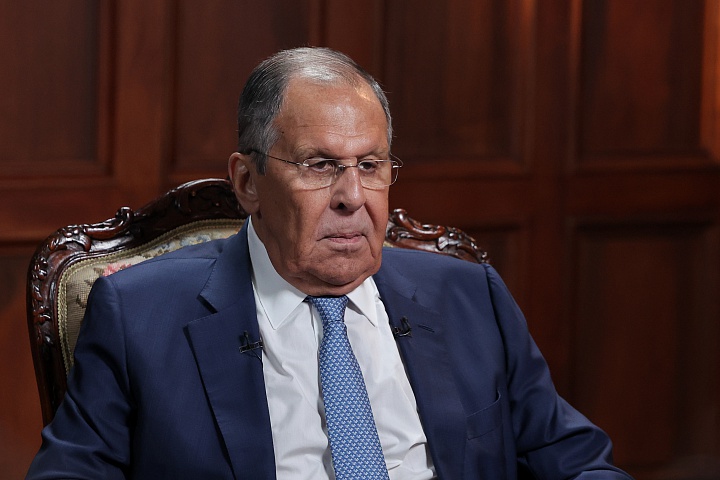
Question: Mr Minister, it is a real pleasure to welcome you to Boshaya Igra television show. Thank you for taking the time to join us.
Allow me to introduce my colleague, Judge Andrew Napolitano, a well-known US television personality and regular contributor to Boshaya Igra.
Sergey Lavrov: Thank you for the invitation. It is a great pleasure to be here with Judge Napolitano and you.
Question: Mr Minister, it is a great pleasure for me to be your guest here at the Reception House. Thank you for the opportunity to communicate with you.
Recently, US President Donald Trump’s envoys, Steve Witkoff and Jared Kushner, visited Moscow and met with President Vladimir Putin. What can you tell us about the outcome of their visit?
Sergey Lavrov: Much of the opening part of the talks was broadcast on television, including remarks by President Vladimir Putin and responses from Mr Witkoff and Mr Kushner. Aide to the President Yury Ushakov, who took part in the meeting, subsequently provided detailed comments on the talks.
It is part of our diplomatic tradition to limit ourselves to what we have agreed to make public. I do not want to follow the example of those who are now speculating about what Mr Witkoff and Mr Kushner brought to Moscow and what they took to Kiev. A lady, a member of the Verkhovnaya Rada, has already said that what they brought was far worse than what Ukraine had previously rejected.
Speculation continues. The American side said nothing about further diplomatic steps. The French, however, have already announced from the Élysée Palace that they were involved and that, according to the Americans, direct negotiations with the United States will definitely resume after the Russian State Duma elections. I leave all of this to the conscience of the Élysée Palace, especially since it is notorious for its less-than-ethical approach when it comes to what was said during telephone calls or other conversations.
The substance of the discussions – and I can say this with confidence – is based on the position on the Ukraine issue that President Donald Trump outlined immediately after returning to the Oval Office. First, he said that the attempts to draw Ukraine into the North Atlantic Alliance should be abandoned. He reminded everyone that this had been clear long before President Vladimir Putin. The case was closed, and there was no need to try to revive it.
The second element of the US position comes down to recognising the realities on the ground. I’d like to point out specifically that the issue is not about land.
Some say that since Russia has seized certain territories we should simply stop where we are. But this is not about territory. When we talk about the realities on the ground, we are talking about people who, immediately after the February 2014 coup, were labelled “subhuman”, “species,” or terrorists. When they refused to accept the outcome of the illegal coup, the army, fighter jets, and artillery were deployed against them in flagrant violation of international humanitarian law. Those people were not regarded as humans.
Petr Poroshenko, who was elected president shortly after, said in 2014 that their children – the children of true Ukrainians – would go to clean schools and kindergartens, while the children of those living in Donbass would be left to rot in basements. How do Europeans plan to bring these people back in the hands of the regime when they call for restoring the 1991 borders? Do they simply want to hand these territories over to the Nazis? Or, do they want to punish these people for seeking to preserve their freedom, their culture, and their sense of belonging to the Russian world?
I have addressed this issue on many occasions. What I want to emphasise is that the realities on the ground, which US President Donald Trump and his team, as far as we can tell, continue to recognise – as they did in Alaska – concern the people and the views they expressed during referendums. This applies to Crimea, the Donetsk and Lugansk people’s republics and, of course, the Zaporozhye and Kherson regions. The fact that the Americans base their approach on these realities in their contacts with us, particularly in their discussions with President Vladimir Putin, is something that we view positively and that makes us willing to maintain dialogue with them. They recognise these fundamental principles and are trying to help find solutions based on them. I believe this approach deserves support.
Question: You have just mentioned Alaska and the meeting in Anchorage. Many believe that the Russians thought they had reached an agreement with the Americans, only for it to transpire that this was not the case.
We know that US President Donald Trump signed a memorandum of understanding with Iran and reneged on it a few hours later. Why do Russians trust?
Sergey Lavrov: I would like to ensure absolute clarity and to prevent any misunderstanding. We have commented upon this matter on numerous occasions.
It was not our initiative. The proposal in question was put forward by Steve Witkoff just a few days before the Anchorage meeting. President Vladimir Putin has, in fact, already provided his comments on this situation. To paraphrase his assessment, he acknowledged that there had been difficult moments. He did not give his approval when this proposal was presented to him in Moscow. However, upon his arrival in Alaska, he stated that he had reflected upon it and concluded that any agreement, in one form or another, necessarily entails elements of compromise, yet he was prepared to take responsibility for accepting it, believing that the people would understand his decision.
It was, in fact, an American proposal presented in its original form. Naturally, the proposal lacked certain specifics, yet the fundamental principles of a settlement were outlined therein. President Vladimir Putin accepted all of these principles without amendment. Consequently, I was somewhat taken aback when US Secretary of State Marco Rubio declared in June this year that the United States could not act as a mediator, as it unequivocally supports Ukraine.
Indeed, and as for what subsequently became of those assessments… To refresh your memory, I would encourage you to review the news conference held by Presidents Vladimir Putin and Donald Trump in Anchorage. The phrase “brilliant result” was used, and the term “understanding of the agreement” was also employed. US President Donald Trump characterised the outcome in Anchorage as a productive meeting with considerable headway. He even remarked that, by and large, only a single issue remained to be resolved, which represented a colossal breakthrough. This is, as I recall, close to the original wording. I do not remember it verbatim at this moment.
Of course, subsequently, the European allies of the United States were dismayed, rushed to Washington, and began to exert pressure on the leadership of the American administration.
Several months elapsed. In June this year, at the G7 summit in Evian, President of France Emmanuel Macron boasted that they had “buried” Anchorage. Allegedly, the United States was now aligned with them. Donald Trump was now with them. And they were, once again, all united against Russia. That was the situation as it stood.
We all observed the developments that transpired between the summit in Anchorage, the G7 summit in Evian, and the NATO summit in Ankara, as well as the manner in which these events were reported in the media and presented by politicians. However, it is evident that Europe made no secret of its principal objective – to prevent the Americans from upholding their own proposal, accepted by President Vladimir Putin, in its original, unamended form. That was precisely what Europe sought.
Question: When you look at the American negotiators, they do seem to be serious people who genuinely want to play the role of peacemakers. President Putin himself has said as much. I don’t know Jared Kushner well, but I had a very intense experience with him back when Special Counsel Robert Mueller was questioning both of us separately about our alleged connections and the supposed “Russian interference” channel. Our testimonies matched completely. That experience tells me that Kushner is a man of moral integrity. But precisely because we take them at face value as decent people, I believe we also have to recognise that they represent the United States – and, as Secretary of State Marco Rubio has made clear, the US is very actively backing Ukraine. So how are we to view them – as honest brokers or as interested parties?
Sergey Lavrov: Well, first of all, I have already noted something that sets the Trump administration apart from the rest of the Western world: they actually acknowledge reality. By that I mean both Russia’s legitimate security interests (and let’s face it, they don’t even treat NATO membership as a bargaining chip) and the will of the people who have lived on those lands for centuries, and who, through little more than a quirk of history, ended up as part of the Ukrainian SSR. That recognition is no small thing. And if the people we’re now dealing with can accept the obvious, it really shows you how far the rest of the West has fallen, since they refuse to acknowledge even the most glaring facts.
I met Jared Kushner during Donald Trump’s first term, when the President received me at the White House. We exchanged a few words. He struck me as an agreeable and trustworthy sort. And I have spoken with Steve Witkoff during Trump’s second term – he, too, clearly wants to get a deal across the line. That said, it is obvious that, as versatile negotiators juggling multiple tracks – Iran, Palestine, and the broader Middle East – they don’t have oversight of the entire US-Russia relationship.
As you rightly pointed out, the State Department is somewhat on the sidelines, much like our own Foreign Ministry (we simply carry out the instructions we receive from the President of Russia). The people directly involved in the talks are, in our view, the ones who match the level and position of the two US negotiators.
But in parallel, the other players responsible for the rest of the US-Russia relationship are ploughing ahead on their own, regardless of whether they have any interest in the success of these negotiations.
Take Congress, the Administration, the Treasury – they have unconditionally extended every last sanction imposed under the previous administration, what you might call Biden’s Congress. Now, President Trump says “this is Joe Biden’s war, and it would never have happened if I’d been president” – but we have to be realistic about what’s actually happening on the ground. On top of the Biden-era sanctions, we are now seeing new ones coming out of the current administration – against Lukoil and Rosneft, for example. And Treasury Secretary Scott Bessent is openly talking about doubling down on sanctions and bringing global energy markets under US control. All of that sits rather awkwardly alongside the constructive tone of the negotiations. But that’s life – and, as always, life is full of contradictions.
The MAGA slogan – “Make America Great Again!” – and the ideology behind it haven’t gone away. That’s plain to see in their approach to Russia. It’s a simple fact: the Americans want economic dividends. And yes, they understand that to get those dividends, they can’t treat Russia the way they might treat some other countries. Whether that actually leads anywhere – I honestly couldn’t tell you at this stage.
Question: Speaking of Europeans, what are they going to do about the positive momentum generated during the Moscow talks? Jared Kushner and Steve Witkoff arrived in Kiev and had a meeting with Vladimir Zelensky followed by a session involving European representatives from the United Kingdom, France, and Germany.
Sergey Lavrov: We have a saying about a piano conveniently placed in the bushes meaning an obviously pre-arranged meeting.
Question: Exactly so. I’m sure they want to pull that piano out of the bushes and play an increasingly active and hostile role. What’s your take on Europe’s position? Are you concerned that, just like after Anchorage, they may derail everything we are trying to accomplish?
Sergey Lavrov: The Anchorage summit is not the only event on that list. Europe’s role in Ukrainian affairs deserves to be researched separately as does its role in the life of our planet over the past 500 years, during which Europeans lived at the expense of others. This includes slavery, colonialism, exploitation, and much more. Let us also not forget that the two world wars started in Europe and were caused by European policies.
The Napoleonic Wars come to mind when the leader of a bellicose country rallied all of Europe under his banners to invade Russia, just as Adolf Hitler did later. Europe is regarded by many as the spawn of evil in world history. By the way, when European colonists set out for the American continent – not that we rarely talk about it, but we should not lose sight of it either – Catherine II played a decisive role in supporting the colonists against the British colonial rulers.
We should be mindful of the historical roots of our relations. These relations varied across different eras, including during the Cold War. During the Great Patriotic War and WWII, the alliance – something I have repeatedly discussed in my recent remarks- ultimately played a major role. Many researchers note that Lend-Lease and the Arctic convoys made a substantial contribution to helping the Soviet Union withstand the first year of the war. Then there was a pause, a period of waiting. Some historians now view this period of waiting as an attempt by our allies – the British and Americans – to determine which way the balance of advantage would shift. Nevertheless, the opening of the second front probably did not play a decisive role, but it was a bond of comradeship in arms. One only needs to look at the newsreel footage of Elbe Day to understand that it was a very sincere bond among those who fought Nazism with weapons in their hands. It was the Spirit of the Elbe, if you like. I would not seek to immortalise the Spirit of Anchorage, but there was no spirit in Anchorage; there was a sense of understanding.
Back to Europe, the Europeans had an immense number of opportunities to play a constructive role. They believe that there can be no talks without them, that they must be at the negotiating table, and so on.
They were at the negotiating table from December 2013 onwards, when the Maidan protests were brewing. The protests were instigated by a number of Europeans and Washington. Victoria Nuland, then Assistant Secretary of State for European and Eurasian Affairs, personally directed preparations for the militants, handing out cookies. The Europeans, represented by France, Germany, and Poland, initiated talks between Ukraine’s President Viktor Yanukovych and the opposition, which was bent on seizing power. On February 21, 2014, an agreement guaranteed by the EU was signed between Viktor Yanukovych and the opposition.
The agreement to hold early elections was a concession on the part of Viktor Yanukovych. Until the early elections, he agreed to relinquish most of his authority, while the country was to be run by an interim government of national unity. The next morning the coup took place. Disregarding the signatures of Germany, France, and Poland, the militants seized government buildings, and the West simply swallowed it all.
President Vladimir Putin often referred to this more recently. When the agreement was ready to be signed, then US President Barack Obama called him and said that the Ukrainians had come to terms. He realised we weren’t comfortable with everything about it, but asked us not to talk Viktor Yanukovych out of signing it. President Vladimir Putin replied that Yanukovych was an independent and internationally recognised head of state, and if he was signing something in that capacity, how could we possibly interfere with his decision on the matter?
The agreement was signed on February 21, 2014, and the very next day, February 22, the coup occurred. By the afternoon of February 22, all Western representatives from France, Germany, and Britain began commenting on media reports that Viktor Yanukovych had allegedly fled and was no longer in Kiev. He was in Kharkov attending a congress of his party. The French, Germans, and British reported that “the people had finally made the right choice.” The ink on the document guaranteed by the Europeans was still fresh.
They had a second chance in February 2015, when the relevant agreements were reached after the marathon negotiations in Minsk. These agreements were signed by the then Chancellor of Germany, Angela Merkel, and the President of France, François Hollande, alongside Russian President Vladimir Putin and Ukraine’s then President, Petr Poroshenko.
A couple of years ago, Merkel (now retired), Hollande (who is also out of office) and Poroshenko all claimed – not merely candidly but with a certain pride – that they had never intended to implement those agreements. They said they desperately needed to buy time to pump Ukraine full of weapons. That was yet another opportunity for the Europeans.
The third opportunity for Europe (there were other episodes, but I will mention only the most significant ones) came in April 2022. At that time, Russian negotiators in Istanbul, much like President Putin later did with regard to the US proposal in Anchorage, accepted the terms put forward by the Ukrainians, agreeing on the principles for building a comprehensive peace treaty. The document was initialled. President Putin made this clear on numerous occasions, including on camera, in talks with his counterparts.
The then British Prime Minister, Boris Johnson, claimed he had not forbidden anyone from doing anything, adding only that if Ukrainians wanted to fight, Britain would stand with them. That is a lie; we know what he actually said. David Arakhamia, who still leads the Servant of the People party in the Verkhovnaya Rada, acknowledged that this was not the case: Boris Johnson told the Ukrainians not to sign anything.
The Europeans had further opportunities to adopt a position as sensible and responsible as that of the Trump administration – that is, to consider the actual facts and developments “on the ground,” including the views of those who live there. Instead, they keep climbing onto a fence that will be very hard to get down from. Time and again, they declare that Russia must suffer a “strategic defeat.”
Just the other day, either EU foreign policy chief Kaja Kallas or some other European Union “talking head” said that they needed to provide a little more support – just a little more for “Ukraine to defeat everyone.” They insist that they will never recognise anything that violates Ukraine’s territorial integrity.
And why is all this happening? Because, as they claim, Ukraine is upholding European values.
But this amounts to a confession, an admission of guilt. If that is the case – and they keep saying so for years – then by “European values” they mean the blatant manifestation of genuine Nazism, racial discrimination, and discrimination on the basis of ethnicity or religion – all in defiance of the UN Charter, which requires respect for human rights regardless of gender, race, language, or religion.
The Russian language is banned. Meanwhile, in Israel, neither Arabic nor Farsi is banned. In Iran, Hebrew is not banned; synagogues operate there, and there is a Jewish community. Yet, Ukraine is the sole country to have banned not just any language, but an official UN language. This has led to people being refused service in shops; all Russian-language classes in schools shut down; Russian-language media outlets – including those owned by Ukrainians – closed; and the canonical Orthodox Church legally banned. And this – so they say – is “European values.”
Apparently, “European values” also include the scenes we see in abundance every day on television and social media, where territorial recruitment centres forcibly round up citizens, snatching them off the streets like cattle and shoving them into buses. You see ten strapping men grab a young man, drag him away, force him into a uniform, thrust an assault rifle into his hands, and ship him off to the front. So this, too, is apparently what “European values” boil down to.
That is why, when Europe says, “No, we must…” – look, you have had so many chances, and you have squandered every single one. So now, if you want anyone to trust you again, you will have to make a serious effort to explain exactly what you intend to do this time. And that will not be easy.
Question: Mr Minister, it’s rather obvious to any neutral observer, and even to many people in the West, that Russia will certainly achieve a military victory during the special military operation, and that this will happen quite soon. Do you think there is a plan? What will happen with Ukraine after the Russian military victory?
Sergey Lavrov: Actually, Mr Napolitano, this will be a continuation of my answer to the previous question. Apart from those who furiously – there is no other word for it – demand the restoration of the 1991 borders, seeking to throw people of Russian culture who have lived there for centuries into a genuine concentration camp, apart from these people, there is a group of other people who periodically show signs of realism. Some of these, including the president of Finland and the prime minister of Italy, have started speaking of the need for an immediate ceasefire. But this is also just a way to buy time, as everyone knows. And Zelensky makes no secret of that. He says, “We urgently need Patriot missiles and more air defence systems; we must save our state,” and so on and so forth.
But the majority of those who are making this plea call for a ceasefire − they all call for a ceasefire − say that when the hostilities stop, they won’t recognise any of the territories Russia controls. Some say that the situation must be put on hold without delay, that Ukraine must be urgently issued guarantees comparable to Article 5 of the Washington Treaty, and that an international stabilisation force must be deployed in the territory that will remain under Kiev’s control.
We have already responded to that. We said that any people in military uniforms and any military facilities will be legitimate goals for us, and no scenario under which Ukraine will acquire NATO membership in all but name is acceptable to us.
But the main thing is that both those who demand a return to the 1991 borders and an immediate halt to the hostilities, and those who call for an end to the hostilities and hint that they would recognise what had actually happened in south-eastern Ukraine after we launched the special military operation in response to the war waged against us through the Kiev regime – both of them also speak about the preservation of the regime currently ruling in Kiev. This implies the preservation of the distinctive features of that regime which I have mentioned: Nazism, aggressive Russophobia, violations of human rights, language rights and religious freedom. All these “European values” will be further consolidated after the active military phase is put to an end in one way or another.
As for their elections, they mentioned the possibility of the elections, but now they say that this should not be done. It would be particularly strange to hear that from the Americans, who hold elections every two years at all costs. The Americans are acting realistically in this instance too.
As for Europe, it wants to preserve that openly Russophobic and aggressive neo-Nazi regime. It is the European plan. I don’t see how Russian people can accept this outcome.
Question: How can you satisfy the Russian people – how can we ensure that they won’t be going through this again in 25 years, that those living in western Ukraine won’t invite NATO in, and that they’ll be able to fight back?
Sergey Lavrov: Everyone keeps talking about Russia needing a “buffer zone.” Well, let Ukraine be that buffer.
We’ve discussed this many times – both the President and your humble servant – how modern Ukraine came into being. Back then, by the will of the Soviet leadership, western territories were attached to the Soviet Union – lands where, for centuries, fiercely nationalist elements of various European nationalities had made their home. But to somehow temper that radicalism, they decided to “dilute” it, as we put it, by adding original Russian territories to these new western acquisitions. And the whole thing was christened the Ukrainian Soviet Socialist Republic. That entity is no more.
But this rather artificial entity – which, as a state, had only a few decades under its belt – existed within the framework of a single state, the Soviet Union, that guaranteed the rights of all its peoples and ensured its own security. Once that odd coupling – part hedgehog, part trembling doe – became independent, and after the collapse of the Soviet Union, the deep-seated civilisational rift between the so-called Western Ukrainians and the Russians of the south-east began to tear open – and it very quickly became a festering sore.
These contradictions run deep, and from the very start, Europe poured fuel on the fire. I remember the 2004 Maidan all too well – when the Americans and Europeans refused to accept the results of the second round of the presidential election and twisted the arm of Ukraine’s Constitutional Court (you might find this interesting) into ordering a third round, even though the Constitution doesn’t provide for one. So they held that third round and got the result they wanted. Then, even before the vote, we started hearing public demands from the EU: “Ukrainians must decide who they are with – Russia or the West.” That “either-or” rhetoric, that pitting of anyone who doesn’t want to break with Russia against “European values” – that’s been festering in them for a long time.
We’ve covered this ground many times, but the fact remains: the Ukraine we once recognised as a legitimate actor in international politics no longer exists. There is no Ukrainian SSR. We recognised the independence of present-day Ukraine on the basis of the Declaration of Independence adopted in 1990. That declaration, passed by the Verkhovnaya Rada, explicitly stated that the Ukrainian state undertakes to be nuclear-free, neutral, and non-aligned.
Today, all three of those pledges have been thrown out the window. Vladimir Zelensky openly said at the start of 2022 that they’d supposedly made a mistake in giving up their nuclear weapons. And quite a few politicians have started hinting, quite seriously: why not use the know-how and technology, essentially developed during the Soviet era, to reclaim that status? I don’t want to talk about NATO anymore. They now claim that membership in both the North Atlantic Alliance and the European Union will guarantee their security. But let’s be clear: from now on, the European Union is behaving as a military bloc, much like NATO. Every single principle that was once proclaimed as the foundation of the Ukrainian state – principles that allowed us to recognise it as an independent subject of international relations – has been abandoned.
Question: Looking at what Europe is saying and doing leaves a strange impression. On the one hand, they say that Russia would not venture to cause an escalation, would not use a nuclear weapon and would be too scared to target their territory with retaliatory strikes. On the other hand, they have been obsessed with preparing for 2029 or 2030 when they claim Russia is most likely to attack. Europe is rapidly switching to a military footing. This goes beyond funding armament programmes worth many billions or trillions, but also creates an impression that regardless of whether peace is reached in Ukraine, they will carry on with this militarisation effort. Considering this situation, I have a question. Do you think that they are scared of us to this extent? Could it be that they use the so-called Russian threat as a pretext for stepping up defence manufacturing and are preparing to launch a large-scale attack against Russia?
Sergey Lavrov: I think that militarist circles are simply catering to their interests. Today, funding is being rerouted to satisfy military needs despite the fact that a growing number of increasingly urgent and deep-running challenges has been accumulating. This includes the commitment to increase defence spending to five percent of GDP within NATO, as well as the fact that political parties are urging their parliaments to immediately allocate another 90 billion euros to Ukraine next year.
These developments have delighted the military industrial complex by netting them huge profits. Moreover, in another public statement Chancellor of Germany Friedrich Merz said that yes, he does understand that the situation has become much worse for his people, but they still had the duty to do this for the sake of Ukraine and European values.
How did they respond to the election results in Saxony where Alternative for Germany won by a wide margin? They are trying to accuse it of reviving Nazism, while this party, even if there is no doubt regarding its nationalist identity, simply advocates dialogue with everyone.
The policy to militarise the Arctic also raises concerns. The United States, the Norwegians and some other forces have recently held military exercises there with the script hinting at the expected war with the Russian Federation. What is behind these efforts? I do not think that they would attack Russia by claiming that we are preparing an aggression against Europe. This would be ridiculous. On the one hand, they say that Russia is losing and this is why Ukraine must be supported in every possible way by stepping up this assistance. This way, Ukraine will win. At the same time, Russia, which they believe to be on the losing side, is preparing to attack Europe. It is not serious for politicians to talk this nonsense. Nevertheless, President Vladimir Putin said and reiterated several times: “Russia does not intend to attack anyone, and making these claims is stupid and retarded, demonstrating the inability to live up to a certain level of statesmanship. Should these conversations imply that you are preparing to attack, let me assure you that this would be a totally different kind of war and that it would be very brief.” My advice would be to remember these words.
There is also the possibility of a trigger event as the one which led to World War I. On a basic level, this is what happened with Archduke Franz Ferdinand in Sarajevo. Considering that Europeans have a knack for intrigue and reckless undertakings, and their treacherous posture, can they organise something along these lines? What about setting the Reichstag on fire? I believe that anything of this nature can happen, just as they have come up with the drone incident in Leipzig and threw a worldwide temper tantrum without showing a single piece of evidence.
By the same token, we did not receive a response to the questions we have asked so many times about Bucha where, in April 2022, they surprised everyone by showing dozens of dead bodies who were carefully placed along the road. Even today, we have yet to receive an answer from the UN Secretary General, the UN High Commissioner for Human Rights and our Western interlocutors, including the United States, on whether they could use their authority to obtain a list of the people whose corpses were shown by a BBC crew, which happened to be on the scene just at the right moment. No one has responded to our enquiries.
We are told that the relatives are reluctant to do this. Bot nobody heard anything about them. It is impossible for family members of the victims not to form some kind of a group or association when dozens of people die in a mass killing and war crimes are perpetrated. But there is total silence in this case. This is why I cannot rule out that this was a provocation.
Question: When examining the governments of European countries, it appears that they diverge significantly from the findings of public opinion polls, suggesting that public opinion in Europe is considerably more peace-loving than that of the European elites and the globalist elites. My question, therefore, is whether it is possible to reach any agreement whatsoever with these globalist elites. You stated recently that, at this stage in the conflict, the decisive factor is not diplomacy but our compelled recourse to the use of force. In your view, can this situation persist , in which Ukrainians are able to launch missile and UAV strikes against our territory – either supplied by the West, manufactured with Western assistance, or directly guided by the West – whilst we limit our responses strictly to Ukrainian territory? How long can such a state of affairs continue, and can we manage without strikes on Europe?
Sergey Lavrov: The guests participating in your programme have already commented on this subject – combat operations and diplomacy. I see no reason why these cannot proceed concurrently; indeed, there have been such historical precedents.
After we were deceived in April 2022, when we had been ready to accept the Ukrainian proposals, had initialled them, and were awaiting the commencement of the drafting of a full-fledged treaty, President of France Emmanuel Macron telephoned President Vladimir Putin and asked him to make a gesture of goodwill to improve the atmosphere for the signing – to withdraw troops and observe a pause. When this deception became evident, President Vladimir Putin affirmed that we remained open to negotiations; however, throughout the course of any such talks, we would not cease to pursue our objectives by military means. This approach persists to the present day. We have proposed two- and three-day ceasefires for Easter and Victory Day. Most recently, at the request of the American side, a three-day ceasefire was declared; we refrained from the use of force in order to facilitate the travel of American negotiators to Kiev.
Our response to terrorist attacks against peaceful civilian infrastructure deep within Russian territory began some time ago and has proven, by the Ukrainians’ own admission, to be considerably more punishing for them. This, too, explains the current urgency with which the West is calling for a ceasefire. Nevertheless, we will not refuse negotiations when we know that those offering talks are doing so with the intention of addressing the problem rather than issuing ultimatums.
The American negotiators – Steve Witkoff and Jared Kushner – are seeking to resolve the issue, and are not advancing demands that are, firstly, unjust and, secondly, impossible to fulfil. Europe, however, is engaged in precisely the latter.
Question: You recently warned that the German authorities have begun to speak of a new war. What prompted you to make such a statement?
Sergey Lavrov: First and foremost, this is because Chancellor of Germany Friedrich Merz never misses an opportunity, in each of his addresses, to reiterate his conviction – a conviction which, he says, grows stronger with each passing day – that Russia constitutes the principal threat to Europe, and that Europe must prepare for war against this threat. Moreover, Germany must – and I never tire of quoting him – once again become the preeminent military power on the continent. That is to say, just as Germany perceived itself to be the principal military force on the eve of the First World War and once again on the eve of the Second World War.
This is no Freudian slip. They genuinely believe this; they persist in honouring their ancestors who dutifully served Nazism and participated in war crimes, maintaining that those forebears were in the right. It is hardly coincidental that they so ardently support Vladimir Zelensky, who is now exhuming from European graves in Austria, Romania, and elsewhere the remains of Ukrainian Nazi criminals, condemned for all time for offences unequivocally recognised as criminal by the Nuremberg Tribunal. He subsequently reinters them in Ukraine, at the most sacred site in Kiev – the Kiev-Pechersk Lavra – where he has proclaimed the establishment of a “citadel of heroes”: Stepan Bandera and other criminals permanently tainted by their actions and their association with the Ukrainian people. For him, they are heroes; he kneels before the coffins containing their ashes brought from Europe. Europe gladly assists in the creation of such “pantheons,” for they never explain to this figure the significance of his actions, nor how these correspond to purported European values.
Consequently, I cannot rule out the possibility that individuals such as Chancellor of Germany Friedrich Merz might once again attempt to emulate the deeds of their forebears.
Question: My next question concerns the Russian ship seized by Norway, as far as I know, in grave violation of international law, without any accusations regarding this vessel’s alleged censurable activity but simply because the Norwegian court decided to respect the demands of Ukraine’s Naftogaz company – not against the vessel per se but rather Russia in general.
Foreign Ministry Official Spokeswoman Maria Zakharova called it piracy. I believe the definition is correct. What are we going to do about this incident, Mr Lavrov? Of course, I feel bad for the ship and even more so for the crew. But my concern is that the Western, European aggression against Russia is growing. Every time we do not retaliate in kind, their feeling of impunity grows. President Putin said that, if necessary, they can expect their teeth to be broken. Are we ready to do that and if yes, how?
Sergey Lavrov: Absolutely. President Putin said that. It is not just a figure of speech but a firm stance.
Regarding the vessel that has nothing to do with anything but research and tourist activity on Spitsbergen, in full compliance with the 1920 Svalbard Treaty, this entire story is, of course, a disgrace for Norway’s judicial system and mainly for the Norwegian state.
Simply because Naftogaz first stated in some Ukrainian courts, and then in others, that the results of the referendum in Crimea should not be recognized by anyone. They claimed that Crimea belongs to Ukraine and Russia’s actions were illegitimate. Apparently, they lost a certain amount of money along with equipment and investment – so, distinguished international community, please be so kind to steal for us anything that is not secure enough and compensate for the Crimeans’ expression of free will in response to the state coup and the fact that the Crimeans were targeted by armed militants and called terrorists.
This is a disgrace for Norway. I have already said that I’d rather not go into details but Norwegian officials and politicians understand it is a disgrace. They are in contact with us and they don’t know what to do.
These are some very dangerous trends, starting from the attempts to seize so-called shadow-fleet vessels. Here is how it goes: they seize a tanker that carries oil in Russia’s interests under a flag of an African country – I’m not going to point fingers – and claim that the flag is fake.
What actually happens is that, as soon as a tanker is seized, the ambassador of the country under which flag the tanker operates goes to the Foreign Ministry or the Executive Office and hears something along the lines of, “Well, we have an assistance programme for your country and we will suspend it if you don’t de-flag the ship and say that the flag is fake, immediately.”
This is the Western justice system as it is. But I can’t and I have no right to go into details. The President said it all. Just as, when asked about British provocation, he answered that it is classified military information.
Question: We have just a few minutes left, and I would like to ask you about the statements coming out of Washington. Is there a real possibility of a meeting between the three presidents in China in November this year – President of Russia Vladimir Putin, US President Donald Trump and President of China Xi Jinping? Is this simply a proposal coming from the US, or is there a genuine chance that such a meeting will take place?
Sergey Lavrov: This is not a proposal from the US, China or Russia. If you like, it is a matter of political experience.
When the leaders of the three largest world powers – economic powers above all, in the case of China, and military powers, in the case of Russia and the United States – happen to be in the same place at the same time, then any political analyst worth his salt will naturally start putting two and two together. I think that’s how it is.
I have no doubt that if such an opportunity is proposed to President Vladimir Putin – and it would be in Shenzhen – our Chinese hosts would arrange a programme to accommodate it. If such a proposal is made, I cannot rule out – and, in fact, I am more than confident – that our President would not turn down such an opportunity.
Question: How long do you think it will be before the special military operation is concluded?
Sergey Lavrov: President of Russia Vladimir Putin recently answered this question. He said that war is not something that lends itself very well to predictions, but the fact that we are moving forward and making progress every day is a fact.
Much will depend on how sensible the advice given to the Ukrainian regime by those who control it is. So far, we have heard no sound advice. Instead, there have only been calls and demands to throw more and more Ukrainians into the furnace by rounding up civilians in the streets, forcing them into vehicles and sending them to the front to be killed, along with many other actions that Ukraine is being pressured to take, including enduring the dire – indeed, catastrophic – state of what used to be called its economy.
Question: Mr Minister, thank you very much for this conversation. It is always very interesting and useful for us. Of course, you are currently heading the list of the United Russia party. I wish you success in the elections. All the parties taking part in the elections, of course, have the right to hope for success, but I think that United Russia – and your role in this process – will be particularly important. Thank you.
Sergey Lavrov: Thank you for your kind words.