



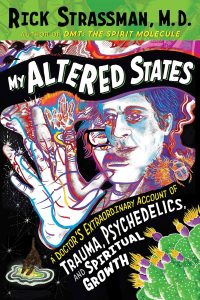
It is our pleasure to welcome Rick Strassman MD, author of My Altered States: A Doctor’s Extraordinary Account of Trauma, Psychedelics, and Spiritual Growth, as our featured author this month. Rick’s research with DMT and psilocybin at the University of New Mexico in the early 1990s was the first new American clinical psychedelic drug research in a generation. Author or co-author of nearly 50 peer-reviewed papers, serving as a guest editor and reviewer for numerous scientific journals, and consulting for various government, nonprofit, academic, and for-profit entities, Rick has contributed enormously to our collective scientific and spiritual understanding of psychedelics.
In his latest book, Rick provides the reader with a collection of personal narratives, recounting several dozen of his direct experiences of altered states of consciousness from birth to early adulthood — both drug and non-drug-induced states of consciousness. Drawing on a range of explanatory models, Rick provides an intimate, detailed exploration of the meanings and messages behind these experiences, demonstrating the importance of careful, unflinching recollection and documentation of both heavenly and hellish altered states in one’s psychological, emotional, and spiritual life.
In his article here, Rick shares vivid excerpts from the book — from shared hallucinations and moments of transcendent ecstasy to episodes of abject terror — and offers insights into why he embarked on this deeply personal journey of observation, documentation, and interpretation.
Interact with Rick on our AoM forum here.
My Altered States recounts several dozen of my own altered states of consciousness experiences from my earliest childhood (and perhaps before birth) up to the age of 22. Here are some samples:
After having smoked hashish for the first time…
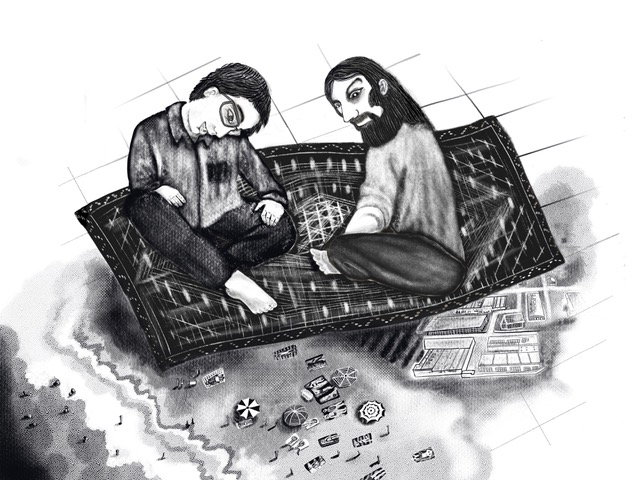
Flying carpet: Image by Merrilee Challiss
Tom and I sit side by side on the rug. I stare wide-eyed at the floor as it gradually loses its solidity, becomes opaque, and finally disappears under us. Tom, also gazing down, notices the same thing,
“Do you see that?” I ask, astonished and a little afraid. “It looks like the floor is giving way.”
“I know. What the . . . ?” He also sounds alarmed.
The floor vanishes but we remain seated on the carpet. It floats slowly, silently, and smoothly one hundred feet above the ground. And it’s daytime, not night.
Tom’s eyes widen and take in the view. “Do you see what I’m seeing?”
“Those telephone poles down there?”
“Yeah. And the baseball diamond over to the left?”
We’re sharing a hallucination.
We look up at each other, confused, and again look down. We’re transfixed by the scene.
Jim stirs and opens his eyes. He sees [us] gesturing toward the floor excitedly. Ambrose and Stu remain immobile and silent, eyes closed, slumped on the bed.
“What are you guys doing?” [Jim] asks.
I wish to maintain the spell and keep my eyes on the scenery while answering, “Flying over outside somewhere.”
“Well, don’t fall off. Ha ha.”
I nod distractedly, as does Tom. Whatever is going on, our safety is most important. We must stay firmly planted on the rug and not get too close to the edge.
Sometimes I pilot our movement through the air: directing the rug, controlling its speed. Then Tom takes over.
“Hey! Watch out for that building!”
“Oops. Sorry, man.”
“Do you see the beach down there?”
“Look at all those umbrellas.”
“Lots of families.”
“Let’s go down and check it out.”
We descend, now to about fifty feet high, and make out greater detail—sandals, coolers, picnic baskets, and blankets. We suddenly drop precipitously.
“Oh, shit! We’re getting too low.”
“Right. Up we go!”
The carpet quickly rises to a safer altitude.
Over woods, mountains, crowds, cars, buildings, we share and confirm myriad details. Another sharp turn and I almost fall off.
“Man, I’m getting tired. This is a lot of work.”
The linoleum tile reappears and solidifies under us. We lurch to a stop, making a minor commotion while trying to stay upright. Pp. 95-97
My second time taking LSD, hiking with my best friend in the San Gabriel Mountains of Southern California.
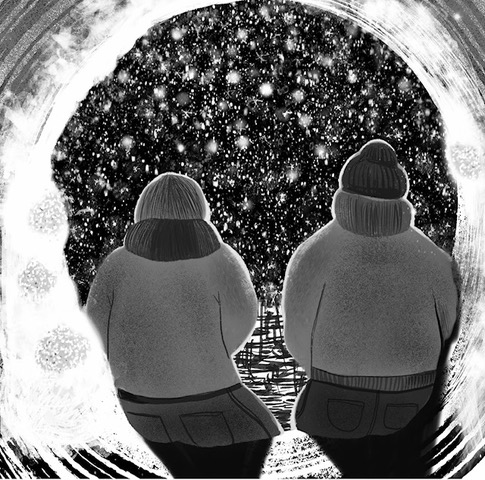
Second time taking LSD: Image by Merrilee Challiss
I lower myself down onto the ground, face up, and close my eyes. Colors, unimaginably brighter than with eyes open. And a simultaneous flood of ecstasy. I wonder: Is this joy the cause of the lights, or are the lights causing the joy?
My body feels cool, light, and airy. Fascinated, I explore sensing my limbs, chest, head, face, and mouth. If I withdraw my attention from them, they drop away. They’re not numb; they’re simply absent, no longer there. It’s empty space. I relax more deeply—letting go of all tension. More of my body drops off. Then it is gone.
I enter a state of perfect completion, absolute equanimity and equipoise, within and without. A state only possible without an inner and outer, no boundaries between my mind and space. Perfection whose essence is endless possibility. A vast timeless infinite horizon opens up before my mind’s eye. Total emptiness, filled to overflowing with something, something potential. The state of potential. Seared with intensity, pulsing with energy, no longer constrained by matter.
What is this? A premonition? Of what—a miracle? A wish? Is it the drug? If so, how? What is LSD? Whatever it is, I love it. More than anything I have ever loved. My mind knows this and my heart sings.
But is it true? I’ve always wanted to feel free, happy, and beautiful—not constrained, criticized, and defective. Whenever I’ve considered my existence, nothing makes sense. I envy what I imagine are the lives of my friends at The College—confident, comfortable, moving toward a clear goal. And today in the snow on LSD, I achieve something new and unfamiliar. I now know that it is possible to direct my own fate. Of course it is. Who else is responsible? Pp. 135-136.
A very bad trip on LSD, again hiking in the San Gabriel Mountains:
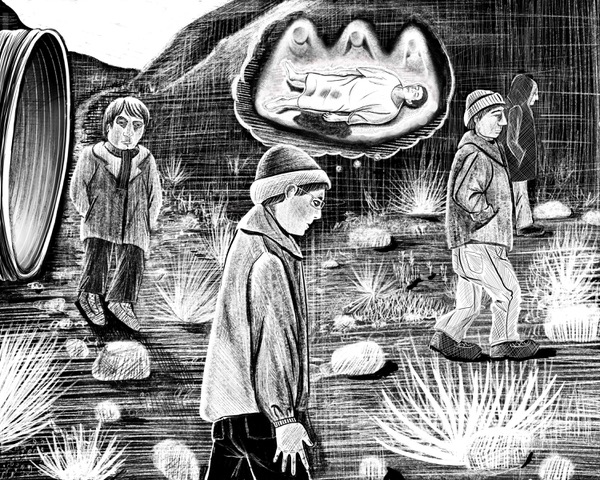
Very bad trip on LSD: Image by Merrilee Challiss
I realize how helpless I am at the moment. Dependent on this group for my survival, a survival that consists of returning to town from these mountains. And the group has turned its back on me, has disappeared me, turned me into an unreality, an absence. How could this possibly go right? I feel the last link to my sanity snap. I adopt a stance of madness….
Even more terrifying: My insanity had prevented me from seeing my insanity. Upon reflection, I realize this has been going on for as long as I can remember. But the nature of the previously disguised information is now suddenly clear. My current crisis of isolation has supplied the last piece of the puzzle. My view of reality is several times removed, connected to my own experience by only the thinnest thread. I am in one world and everyone else in another. I belong in a mental hospital. This is where my life has been leading, and it is finally upon me….
A vision appears. I am in a small, dimly lit seclusion room in a psychiatric hospital, close to the floor. I cannot tell if I am lying in a bed or sitting in a chair, perhaps even lying or sitting on the floor. Wherever it is, I am at an uncomfortable angle, one that forces me to dissociate, to shed awareness of my body. Now it is comfortable, but I cannot move my body. I have no control over it.
I sense a light, a brightness, maybe an overhead lamp, but I can make nothing out, nothing is distinct. I hear, or perhaps simply feel, movement around me. The nurses are wearing nuns’ habits. Maybe they are nuns. I can’t see their faces. It feels as if there are two or three of them. They seem benign, even kind, and have my interest at heart. They are simply watchful, available to help….
In the hospital room, I am lying in, not simply on, the wetness of a semi-firm warm material. I sense it is my own shit, but I cannot see or smell it. There is no discomfort. Perceiving more clearly, it is as if I am just barely raised or suspended over it, or just lightly touching it, a physical lightness. Nearly immaterial. All my sensations are reduced, almost extinguished, but not because of dying. It is the terror that awaits me once my world of sensation and perception are over. It is empty and terrifying. Living and no longer knowing if I were alive. It is an absolutely abstract state, one in which the impossible contradiction exists: that I have always been this way and have not realized it until now. In the little seclusion room and the normal outside world at the same time. No longer. It is insane now all the time and the rest of my life. If indeed I were now alive.
I relax into that world. I could give up. While I dissociate from my body in that little room, I am free. It has been so hard in the outside world. Here is my chance to stop struggling, to stop fighting. To be completely passive. A state of no bearings, no orientation, nothing to ground in reality. And I swing between that state and one with a body, an individual physical self. Pp. 257-261.
***
My Altered States chronicles the role that these unusual experiences have played in my life personally, spiritually, and professionally. I have sought these states out, studied them, provided them to others in the setting of clinical research with DMT and psilocybin, and have used them as touchstones for most, if not all, of the major decisions about my life.
What is an altered state of consciousness? Why are they important? Or, are they? How do we enter into and exit them? How do we make the most of them and avoid the worst of them?
I have been recording my altered state experiences in my journals since my late teen years and have spent endless hours remembering and reconstructing others. While many of those I recount in My Altered States resulted from taking psychoactive substances like psychedelics, cannabis, and alcohol, others came about through meditation and psychoanalysis. Circumstances beyond my control led to others; for example, childhood physical abuse and later a serious mood disturbance in my early twenties.
As is often the case with academic researchers, “research is me-search.” That is, I found these states to be so compelling—either positively or negatively—that they inexorably steered my career. First into medicine, psychiatry, and clinical research; subsequently into psychedelic drug research, Zen practice, psychoanalysis, and Hebrew Bible studies. At the same time, I have worked on integrating altered states into my worldview, conduct, and psycho-spiritual growth.
This, then, is a memoir of altered states of consciousness, a portrait of a young seeker born into a certain time and place, with certain abilities and disabilities. There are stumbles and revelations, dead ends and vast panoramas, joyful moments and abject terror, fervent messianic optimism and soul-crushing despair. Ultimately, however, there is no final redemption, no tidy ending. It is simply an account of my efforts to become free, and in so doing, make the world a better place.
In presenting these accounts, I rely on skills I have developed and honed over the years, occupying myself in traditional and reliable paths of inner exploration. One such discipline is psychoanalytic psychotherapy, which I began as a child in an effort to resolve my speech dysfluency. In medical school, I had my first long-term course of psychoanalytic psychotherapy. And in my thirties, I embarked upon a four-year classical psychoanalysis with sessions occurring up to five days per week, lying on the couch. In addition, during my psychiatric training and academic career, I studied and taught psychoanalytic psychology and psychotherapy. And while treating psychiatric patients in academic, community, and private settings, I employed psychoanalytic principles and methods as much as possible. I have no qualms about declaring myself a Freudian when it comes to my psychotherapeutic stance and my understanding of human psychology.
In my early twenties, I began practicing and studying Zen Buddhism under the supervision of a long-standing Western monastic order. I underwent lay ordination, founded and helped run an affiliated meditation group, and maintained close relationships with clerical and lay members of the community for over twenty years. Later, as I matured spiritually, I returned to my Jewish roots and immersed myself in the Hebrew Bible’s language, theology, and philosophy; that is, foundational Judaism. After eighteen years of study, this project resulted in DMT and the Soul of Prophecy (Inner Traditions, 2014), a comparison of the biblical prophetic state of consciousness with that brought about through administering the naturally-occurring psychedelic DMT.
Finally, I draw on hundreds of psychedelic drug sessions I supervised using psychopharmacological, Eastern religious, and psychoanalytic models during my years of research with DMT and psilocybin in the early 1990s at the University of New Mexico School of Medicine. These I present in DMT: The Spirit Molecule (Inner Traditions, 2001), a behind-the-scenes account of the first new American psychedelic drug research in humans in a generation.
All of this groundwork helped me utilize several distinct but overlapping models with which to interpret my own altered states. These exegeses appear after every narrative in a “Reflections” section. In them, I suggest how certain experiences may have come about, as well as attempt to explain their meaning. I hope this material helps clarify general principles that extend beyond simply describing what happened to me any particular day—concepts like set, setting, intention, and dose; the nature of the unconscious; brain networks and psychopharmacology; and metaphysical considerations of the relationship between the worlds of spirit and matter.
Why did I write this book? For a number of reasons. I had just published The Psychedelic Handbook (Ulysses Press, 2022), an introductory textbook for a large and rapidly growing field. The sheer quantity of new data, as well as the need for accuracy in presenting doses and side effects of so many drugs, made for a daunting project. Writing a less technical book was appealing.
I also saw this as an opportunity to self-disclose in a manner that would provide a more balanced, grounded, and less projection-oriented sense of who I am. Someone with plenty of issues to work out, with a long history of trying to resolve them. Because of this deeply personal material, I admit to anxiety sharing it. A significant number of narratives portray me in a not especially flattering light, and I make no attempt to paper over the “warts and all” quality. Well, not entirely, as my intention was to evoke curiosity, humor, sympathy, empathy, and even alarm—but not disgust. I have therefore edited out some material—especially in the lengthy journal entries during a prolonged and serious mood disorder—that requires more context than is possible in a work like this.
As a memoir, these events—and my attempts to understand and integrate them—partake of a literary quality. Therefore, this work joins that of others who have described effects of a variety of mind-altering substances: Charles Bukowski and alcohol, Albert Hofmann and LSD, John Lilly and ketamine, William James and nitrous oxide, Sigmund Freud and cocaine, William Burroughs and heroin, Thomas De Quincey and opium, and Jacques-Joseph Moreau and hashish. It also ventures into the autobiographical literature about altered states accompanying mental illness, such as Jung’s The Red Book and Jamison’s An Unquiet Mind.
When reading any memoir, the reader cannot help but wonder about the character of the author. Who am I as the protagonist? What influenced me to venture so far afield so often? What was I looking for and why? What did I find? What are the themes that run through these accounts? What unites them—if anything? Have I succeeded, and how; or have I not, and why?
Nearly all of these experiences in this book occurred with others. As a matter of course, in order to preserve their anonymity, I change names, gender, occupation, and other personal identifiers, as well as dates, places, and locations.
Finally, Merrilee Challis’s inspired artwork gracing every chapter is essential in visually expressing more than words alone could. Each image epitomizes an episode’s mood—fear, joy, pain, ecstasy, confusion, hilarity, despair, or equanimity. They also capture the characteristic properties of the altered state itself under discussion. For example, with psychedelics, novelty and meaningfulness; with alcohol, disinhibited behavior; and with meditation, enhanced focus and concentration.
Thus, I hope My Altered States shows the value of carefully observing, documenting, and working with one’s altered states of consciousness, regardless of their origin or seeming significance. I also want to give hope to those whose experiences have left them wounded, confused, and grappling for understanding and integration. Here, refusal to become disheartened must remain the highest priority.