


Neville Chamberlain’s perfidious game in 1938 deliberately created a monster in the heart of Europe, setting stage for the continent’s greatest tragedy in history.
This is part 2 of the 3-part reconstruction of the key historical episode that catalyzed the descent to World War II.

In part 1 we traced the beginnings of the Czechoslovak crisis through 1938 and the way Britain facilitated Hitler’s ambitions toward Czechoslovakia while pressuring her government in Prague to yield to Germany’s ever escalating demands. Through the process, the British establishment fomented fear and psychosis among its British subjects to neutralize their opposition to Nazism.
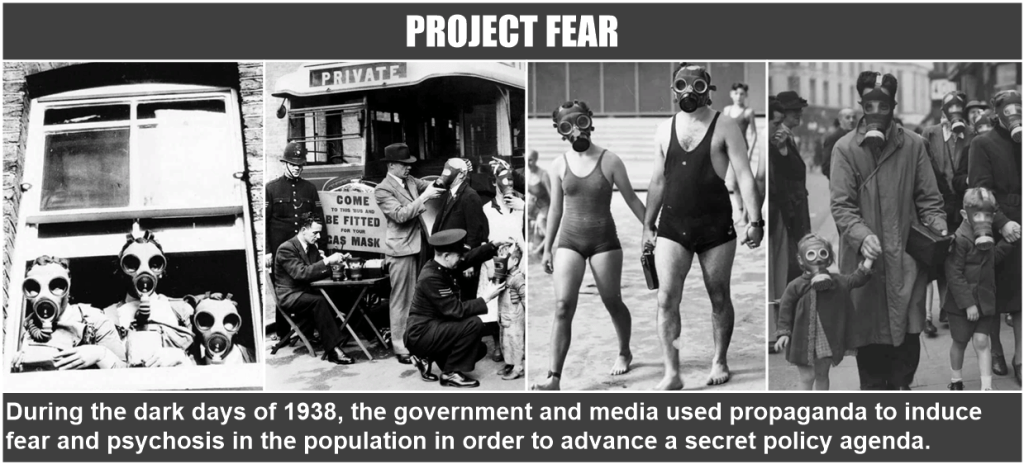
In part 1 of this article, you’ll also find a 45-minute video report that covers all 3 parts.
Pushing Czechoslovakia to commit suicide
As the crisis between Germany and Czechoslovakia escalated through the summer of 1938, France and Britain ordered the Czech government not to mobilize its troops for fear of provoking Germany. Instead, they pressured Prague to accept the Anglo-French solution to the crisis. But their proposal would only further weaken Czechoslovakia’s security in exchange for vague promises of international guarantees.
The government of President Edvard Beneš protested vigorously and rejected the solution. In their turn, London and Paris rejected the Czech refusal and mounted further pressure on the government in Prague. Neville Chamberlain explained the imperative to force Czechoslovakia’s government to yield:
“The idea of territorial cession would be likely to have a more favorable reception from the British public if it could be represented as the choice of the Czechoslovak Government themselves and it could be made clear that they had been offered the choice of a plebiscite or of territorial cession and had preferred the latter. This would dispose of any idea that we were ourselves carving up Czechoslovak territory.”
To turn up the pressure, France threatened to revoke their alliance and abandon the Czechs to Germany. Finally, on 21 September 1938 the Czech government relented and accepted the Anglo-French dictate.
The Godesberg ultimatum
The very next day, Chamberlain paid Hitler a visit at Godesberg on the Rhine in order to personally deliver the good news. At that meeting, Hitler and Chamberlain formulated the extreme Godesberg Ultimatum – a set of even more exacting demands against the Czechoslovak government and had the British military attaché rush them to Prague.
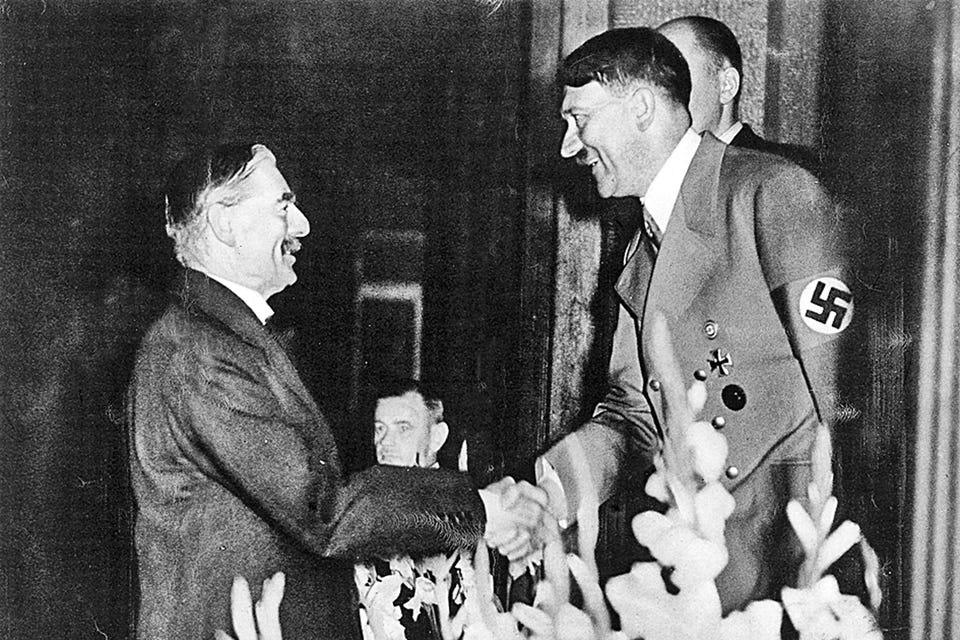
Hitler now inexplicably demanded self-determination not only for the Sudeten Germans, but also for the Poles, Hungarians and Slovaks. In addition, German troops were to enter Czechoslovakia before the 1st October 1938 and occupy portions of Czechoslovakia that would be determined at Hitler’s own discretion. This ultimatum was presented as Hitler’s own brainchild, but it was almost certainly godfathered by Chamberlain himself.
Back in London, on 23 September the British Cabinet ostensibly rejected Hitler’s Godesberg ultimatum and agreed to support France if she chose to go to war against Germany. The French government also rejected Hitler’s ultimatum as did the Czechs. The Soviets responded by explicitly reiterating their security commitment to Czechoslovakia. However, this last-moment appearance of a united front against an aggressive Germany was yet another deception.
Chamberlain’s perfidious double game
What Chamberlain did next was worthy of a cartoon villain. On 27 September 1938, Chamberlain delivered a radio address to the nation feigning his dismay at the incomprehensible events on the continent:
“How horrible, fantastic, incredible it is that we should be digging trenches and trying on gas masks here because of a quarrel in a far-away country between people of whom we know nothing…”
That very same day, Chamberlain sent a telegram to Czechoslovakia’s President Beneš, warning him that if he failed to accept Hitler’s ultimatum by 2 PM on the following day (28 September), Czechoslovakia would be overrun by the German Army and nothing could save her. Recall, there was a reason why 28 September was important: that was the date on which the military brass led by General Ludwig Beck planned to assassinate Hitler if he persisted in his plans to attack Czechoslovakia.
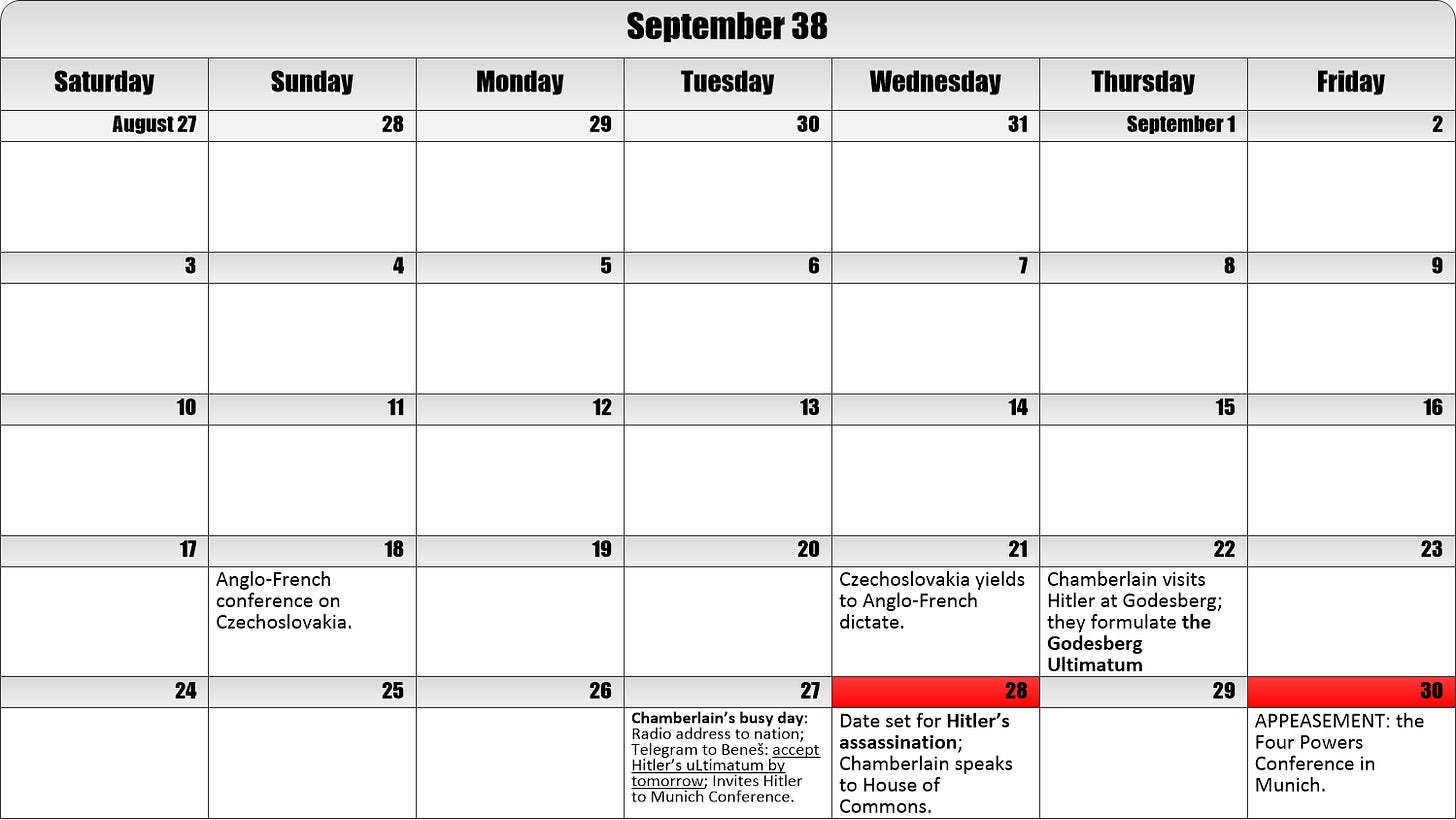
After he sent the message to Beneš, Chamberlain reached out to Hitler to propose holding a four-power conference, reassuring him that Britain and France would force Czechoslovakia to accept any agreement, on condition that Germany abstained from going to war. The following day, on 28 September 1938 at 3 PM, Chamberlain appeared at the House of Commons where he gave a long speech about the events in Europe. His speech caused great consternation among the MPs who sat aghast, wondering if Goering’s bombs were about to start raining down on London.
In a theatrical stunt near the end of his speech, a message was brought to him and he announced at once that it was an invitation to a four-Power conference at Munich. Chamberlain forgot to mention that he himself had organized the conference, but the MPs were not inclined to question the good news: they erupted in a roar of relief and Chamberlain immediately hurried form the building without a formal ending of the session.
The betrayal at Munich
In Munich, on 30th September 1938 Chamberlain, Hitler, Mussolini and France’s Daladier carved up Czechoslovakia without consulting anyone else, least of all the Czechs. The four Powers agreement was handed to the Czech minister in Berlin who had been waiting outside the doors for over ten hours. It reached Prague only eighteen hours before the German occupation was to begin.
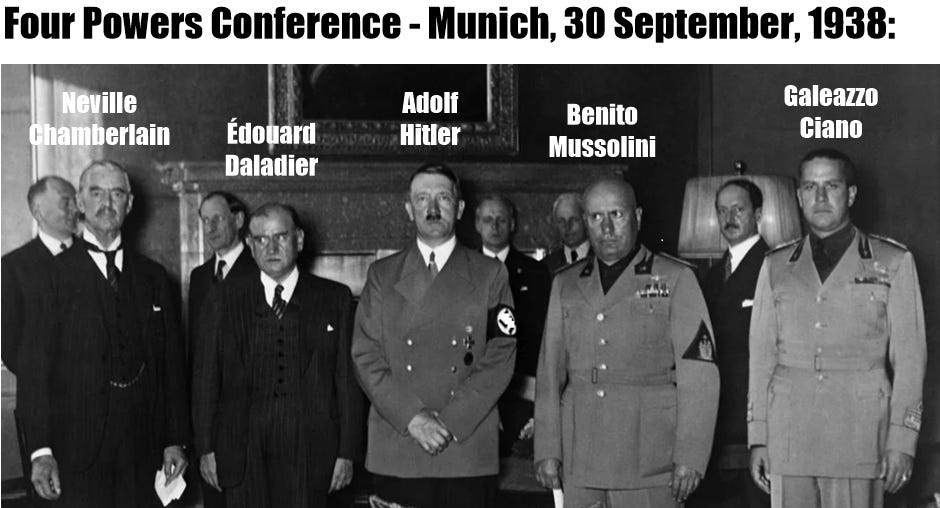
The agreement itself was an abomination. It provided that some designated areas of Czechoslovakia would be occupied by the German army in several stages during the first and second weeks of October 1938. The progress of the occupation would be supervised by an international commission. A joint German-Czech commission would order and supervise public referenda and guarantee the rights of various ethnicities who would have a six months grace period to move into and out of the areas designated under the agreement.
Property was to be protected and none of it was to be seized by the occupying troops. The remainder of Czechoslovakia would be guaranteed by France and Britain, with Germany and Italy joining this guarantee as soon as the Polish and Hungarian minority issues had been settled. But the whole agreement was utterly worthless; it merely put a thin veil of diplomatic decorum over the real agenda, which was a brazen act of destruction of a prosperous central European nation with the premeditated objective of empowering Nazi Germany and pushing the people of Europe closer to the single greatest tragedy in their history.
Almost before the ink could dry on this shameful document, it was violated on every point in favor of Germany which simply occupied whatever areas of Czechoslovakia it chose to. The nation’s infrastructure was severely impaired as every important railroad or highway was cut or crippled, almost instantly collapsing the Czech economy. The international commission that was set up to oversee the occupation process in reality simply rubber-stamped every decision of the German General Staff.
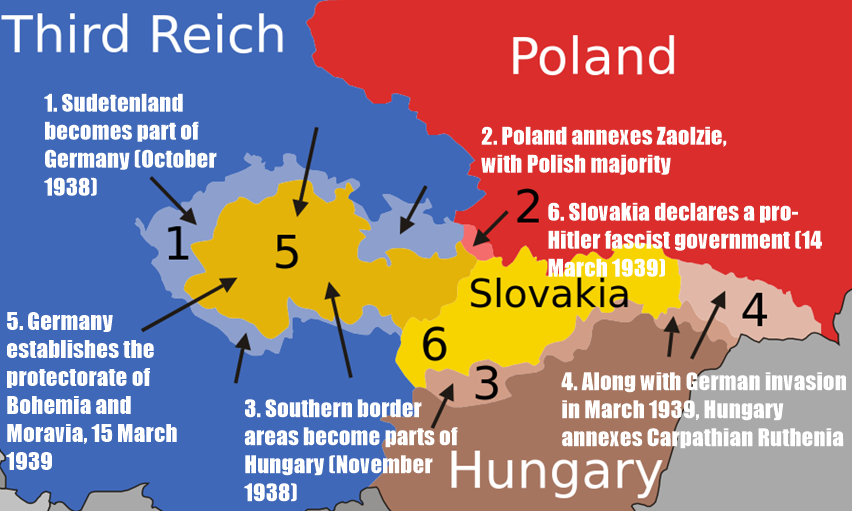
For their neutrality Poland and Hungary were subsequently rewarded with chunks of Czechoslovakia: Hungary obtained a southern portion of Slovakia while Poland took the areas with a Polish minority. Czechoslovakia’s Soviet alliance was abolished and the Communist Party outlawed. Anti-Nazi refugees from Sudetenland were rounded up by the new government in Prague and handed over to the Germans to be destroyed. The stipulated guarantee of the rump of Czechoslovakia was ignored. As for the promised referenda, they were simply forgotten.
Nazi Germany becomes the supreme power in Europe
All that the Munich Agreement accomplished was to give Hitler everything he demanded and more, but without the costs and casualties of war. As a result, Nazi Germany was made the supreme power in central Europe and any possibility of checking its hegemony on the continent was lost. This was exactly as Chamberlain intended it.
When German troops overran Czechoslovakia, they captured 469 tanks which were much superior to German tanks, along with 1,500 planes, 43,000 machine guns, and more than 1 million rifles. The unused arsenal was a posthumous testament to the power that failed to defend itself against Hitler’s aggression. It was sedated and paralyzed through the devious scheming of the British foreign policy cabal led by Neville Chamberlain.
March 1939: appeasement ends, but support for the Nazis continues
Hitler was not happy with the results of the four Powers conference. He seemingly felt cheated out of a war and said that Munich would be his first and certainly the last international conference. The next time, he said, he hoped that no “dirty pig” would suggest a conference. By dirty pig, he was referring to Neville Chamberlain.
Hitler also had no intention to abide by the agreement reached in Munich. By early March 1939 German troops were poised to occupy the rump of Czechoslovakia and there was nothing to stop them. On 14 March 1939 Hitler summoned Czechoslovak puppet president Hácha to Berlin where he forced him to sign documents handing the nation over to Germany and ordering all resistance to the invading German forces to stand down. Within a week, Bohemia-Moravia was declared a German protectorate.
Standard historical narrative holds that the events of March 1939 finally revealed Hitler’s true intentions and marked the end of the naïve policy of appeasement. But for Chamberlain and his co-conspirators, the events were unfolding as intended. However, for their plans to proceed unopposed, it was necessary to continue deceiving the British people.
Chamberlain’s game of deception continues
When Hitler broke the Munich Agreement and annexed Czechoslovakia, Chamberlain issued a feeble protest, but on 15 March 1939 he explicitly accepted Germany’s seizure of Czechoslovakia in the House of Commons and refused to accuse Hitler of bad faith. Two days later, on 17 March, he faced his constituents in Birmingham and denounced Hitler’s actions before the public. And even as he publicly declared the seizure of Czechoslovakia as illegal, his government immediately accepted it as a fact and recognized at law by accrediting the British consulate general in Prague to Germany.
As the public outrage mounted, on 28 March 1939 Chamberlain made a further gesture in announcing the cancellation of trade talks with Germany and the planned visit to Berlin of the British Board of Trade led by its President, Oliver Stanley. True to form, however, only five days later, the German commercial attaché in London was secretly informed that the British were ready to reopen the discussions.
In May 1939, Bank of England’s Montagu Norman turned over to Germany the £6,000,000 in Czech gold reserves that were held in London. When the news of this transfer leaked out, the cabinet hid behind the preposterous excuse that the British government could not control the actions of the Bank of England: their innocent hands were tied, you see.
To be continued…
In part 3 of this article, we’ll look at the way Hitler’s invasion of Poland shaped up, with continued British involvement aimed at facilitating their “three block world” agenda and the way this agenda remains relevant to this day.