


To avoid sleepwalking into another great war, it is essential that we understand what really happened in 1938 – and it’s nothing like they taught us in school.

This is part 1 of the 3-part reconstruction of the key historical episode that catalyzed the descent to World War II. The full report (all 3 parts) is included in a YouTube report below:
The report was released on YT a few days ago and a number of people asked if it was an AI video, so to put that to rest: it is not – it was made entirely the pedestrian way, credit to my nephew, Niko Krainer.
We should prepare for war, apparently
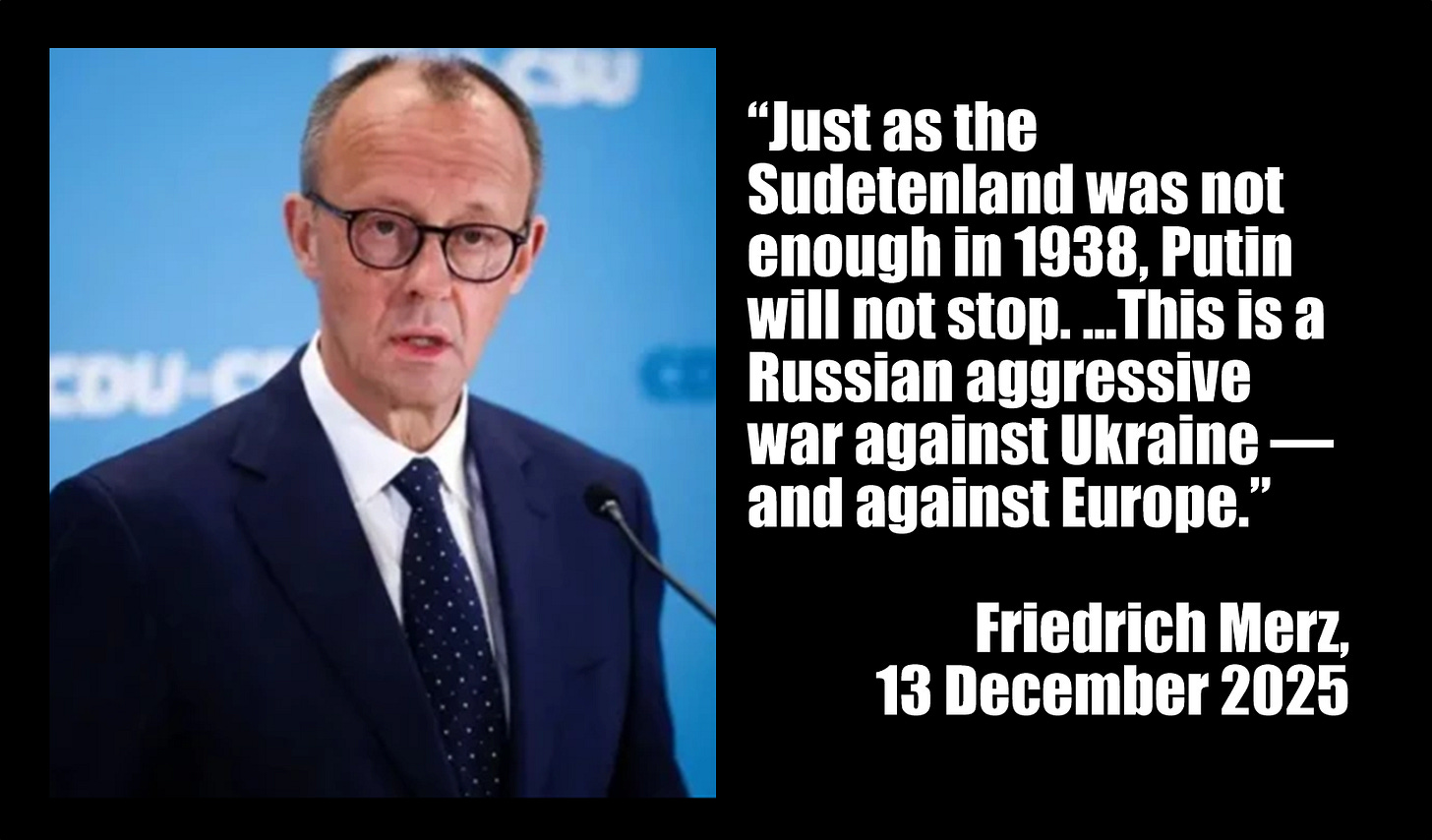
Exactly a month ago, on Saturday, 13 December 2025, Germany’s Chancellor Friedrich Merz addressed a gathering of members of his party, the CDU/CSU. On the occasion, Merz announced that “Pax Americana” was over and suggested that Germany had to prepare for war against Russia – perhaps, as NATO Secretary General Mark Rutte put it, it should be the kind of war like “our grandparents and great-grandparents endured.”
As it happens, Friedrich Merz’s parents and grandparents knew something about that war: his father, Alois Merz, was a member of the Nazi National Socialist party since the early 1930s. His maternal grandfather Josef Paul Sauvigny was a high-ranking Nazi officer who served as the mayor of Brilon during World War II, with the rank of Oberscharfuhrer.
Putin will not stop?
In his speech, Merz implied that Russia’s President Vladimir Putin was Adolf Hitler of our time and warned his applauding party colleagues that, “If Ukraine falls, he won’t stop there.” He warned against the danger of appeasing this new Hitler, insinuating that it might end like the appeasement of Nazi Germany in 1938. Merz reminded his audience that, “Just as the Sudetenland was not enough in 1938, Putin will not stop. …This is a Russian aggressive war against Ukraine — and against Europe.”
In all this, Merz was not particularly original: this same insinuation has been regurgitated by many Western officials over the recent years, including Lech Wałęsa, Mateusz Morawiecki, Kaja Kallas, Gabrielius Landsbergis who’s quite a frequent user of the analogy, Volodymyr Zelenskyy, Boris Johnson, Liz Truss, Ben Wallace, Annalena Baerbock, Marie-Agnes Strack-Zimmermann, Mitch McConnel, Lindsay Graham, Antony Blinken, Joe Biden, and many others. It is clear that we are being sold a narrative to promote the next big European war. However, that narrative is a gross falsification of history. As a result, the truth of those events has remained widely misunderstood.
As one meme doing rounds in the social media says, “If the news is fake, imagine how bad history is!” To avoid sleepwalking into another great war, it is essential that we understand what really happened in the late 1930s – and it’s nothing like they taught us in school. In today’s report we’ll shed light on that hidden history. It is based principally on the following three sources:
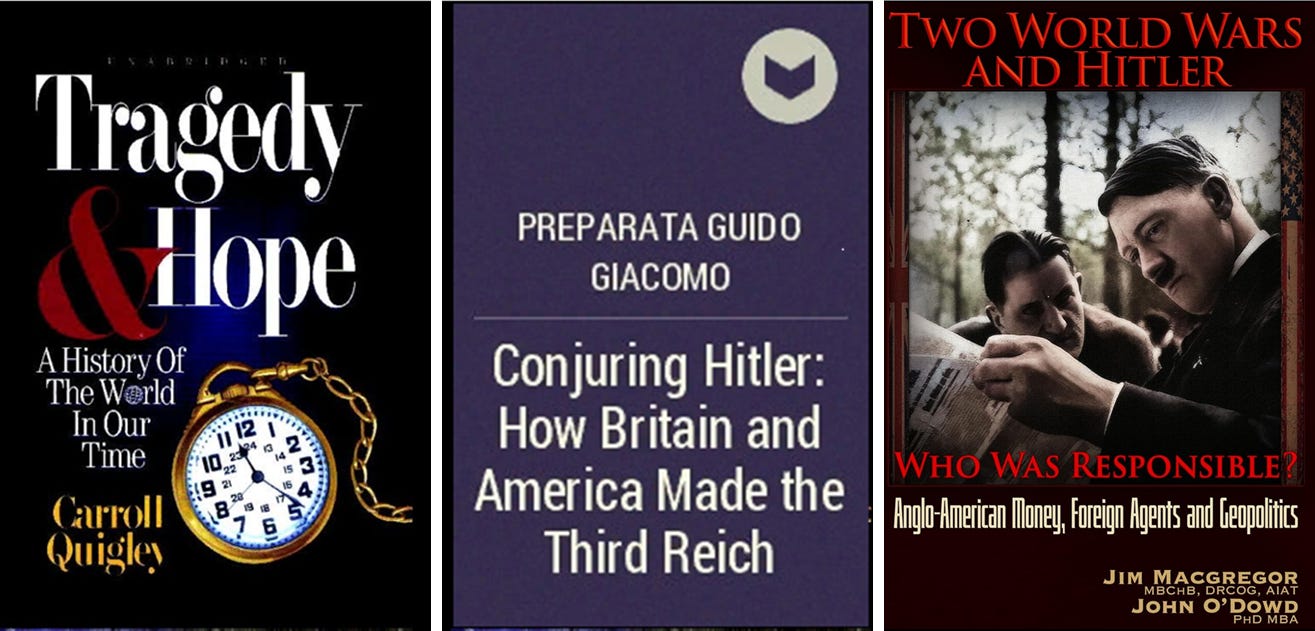
Each of the three books is a masterpiece of historiography and I couldn’t recommend them highly enough. Buckle in, this will change how you look at the world.
The sacrifice of Czechoslovakia
The treacherous sacrifice of Czechoslovakia to Germany is one of the least well understood episodes leading to the tragedy of World War II. Conventional history associates the Czech crisis with Neville Chamberlain’s appeasement at Munich. The story we were taught in school was that the British government agreed to partition Czechoslovakia only as a desperate measure to avoid a greater European war.
This view is based on the idea that Germany was already an overwhelming military power that could easily crush Czechoslovakia’s weak defenses. However, that was patently false. In late 1938 Czechoslovakia did in fact capitulate without resistance, but this was not because her defenses were weak. Rather, Czechoslovakia’s government was paralyzed and sedated as a result of the treacherous scheming of Britain’s secret diplomacy.
The beginnings of the Czech crisis
Created in 1919, Czechoslovakia was the most prosperous, most democratic, most powerful and best administered of the states that emerged from the Habsburg Empire.
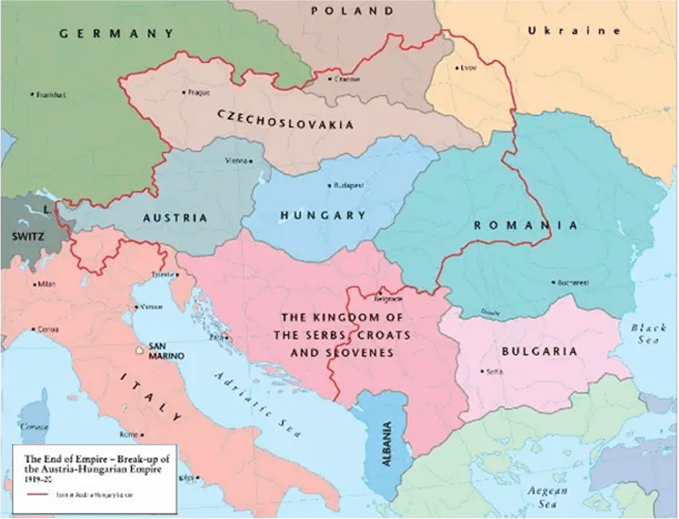
Situated along its northwest frontier with Germany, the Sudeten region was the most industrialized part of the country and had a majority German population. Although Czechoslovakia instituted equitable treatment for all of its minorities, in the 1930s, Sudeten Germans began to press for greater political power and autonomy within Czechoslovakia.
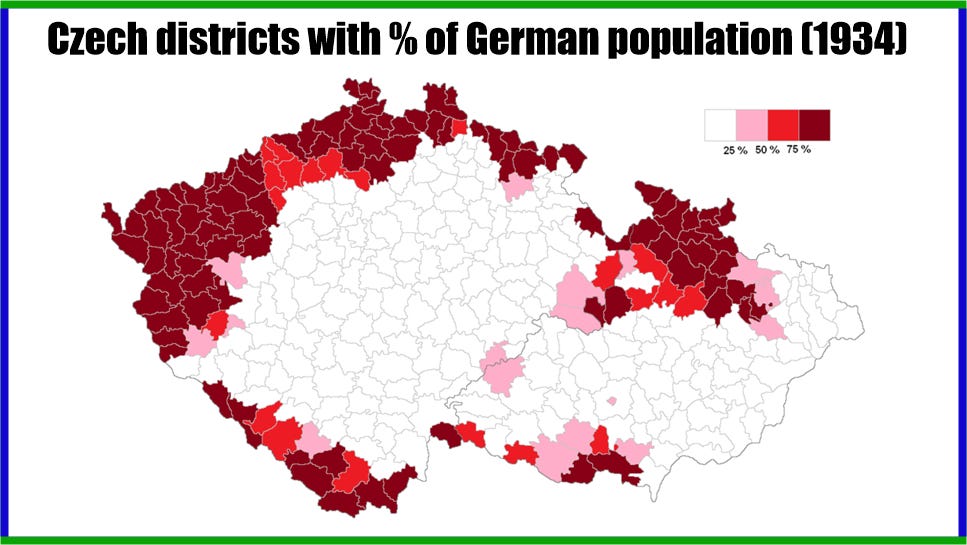
They established their own Nazi party and with funding from Berlin their relentless agitation and propaganda became a destabilizing factor for the nation. In 1934 the Czech government finally banned the party, but under Konrad Henlein’s leadership, they merely changed the party’s name to Sudeten German Party and continued to consolidate influence and power.
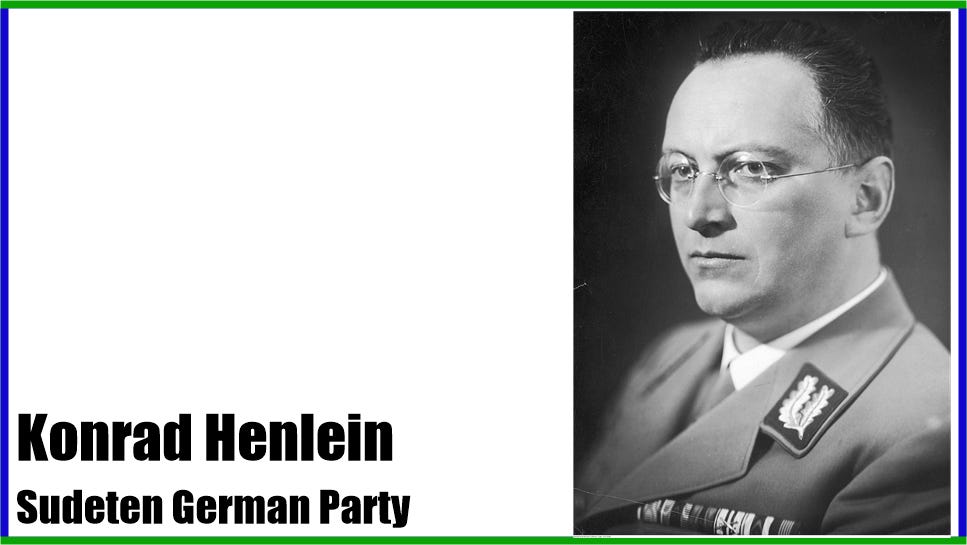
Henlein coordinated his party’s agenda with Hitler and their strategy was to keep pressing the Czech government for ever greater concessions which escalated the crisis to a boiling point in 1938.
School curriculum vs. the truth
Conventional history holds that Britain only became involved in this crisis in order to prevent a greater war from erupting. The Wikipedia entry says that, “Germany had started a low-intensity undeclared war on Czechoslovakia on 17 September 1938. In reaction, on 20 September the United Kingdom and France formally asked Czechoslovakia to cede its territory to Germany…” That pretty much sums up history as it is still being taught in schools everywhere.
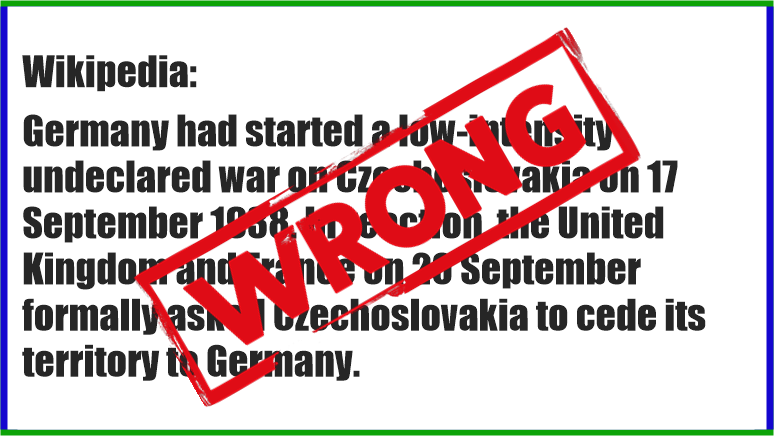
The truth is very different: as early as March 1938, British representatives took a very active role in the negotiations between the Germans and the Czech government and remained involved until the very end of the Czech crisis. Behind the false cloak of impartiality, the British consistently encouraged the Germans to bolster their demands and pressured the Czechs to yield.
The Czech government responded by offering substantial concessions and formulating a plan for the minorities that included economic benefits, cultural and administrative autonomy and even political federalism. But all that was brushed aside by the German and British counterparts as inadequate. Then, on 24 April 1938, Henlein formulated the extreme “Karlsbad Demands.”
After months of torturous negotiations, and under severe pressure from Britain, in September 1938 the Czech government yielded on most of these demands. But at that point, rather than declaring victory and accepting a settlement, Henlein abruptly broke off the negotiations and fled to Germany.
German Wehrmacht was no match for the Czech military
The standard historical narrative invariably presented the Czech situation as a lost cause since the overwhelming power of the German Wehrmacht could easily crush Czechoslovakia’s weak defenses. Chamberlain’s appeasement of Hitler is regarded as an ill-advised and cowardly policy, but ultimately a well-intentioned bid to prevent a greater European war. But all that is a lie. The idea that Germany had a military advantage and that Czech’s security was weak were both fabrications of a sustained propaganda campaign, which was orchestrated by the British media and foreign policy establishment to mislead the British and European public.
To be sure, Germany had been building up its military power since the early 1930s, but in 1938 it was still no match for Czech defenses: the Germans had 35 infantry divisions and only 4 motorized divisions, none of them fully manned or equipped. Of these, only 22 partially trained divisions were stationed near the Czech frontier. At the same time, Czechoslovakia had 34 well equipped divisions and was able to mobilize and arm fully 1,000,000 troops.
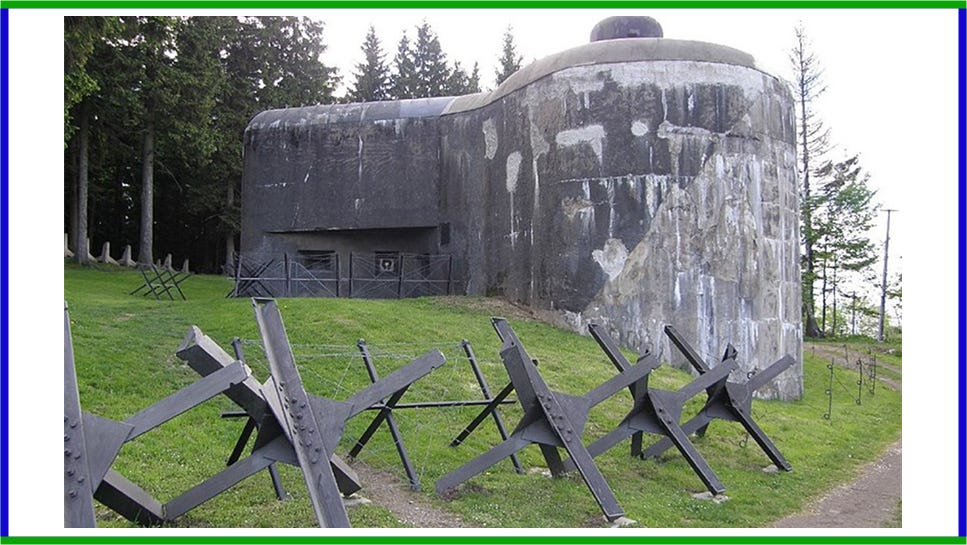
They also had hundreds of tanks that were among the most advanced tanks in Europe at the time. Moreover Czech army was better trained, had very high morale and had built powerful fortifications along its borders. In terms of quality, armaments and fortifications, the Czech army was known to be the best in Europe and was superior to German army in every way except for air support.
On September 3rd 1938 the British military attaché in Prague wrote a cable to London, stating: “There are no shortcomings in the Czech army, as far as I have been able to observe…” In addition, Czech security was supported by strategic alliances with France and the Soviet Union both of whom were at that time very keen on holding Germany in check and both of whom were significantly superior to Germany in terms of military strength.
German generals plan to assassinate Hitler
Germany’s military leaders were well aware of all this and believed that, even without her alliances, Czechoslovakia could easily defeat German army in any military confrontation. When, on 21 April 1938 Hitler ordered General Wilhelm Keitel to draft plans to invade Czechoslovakia, German military brass were deeply alarmed – so much so that a group of top commanders, clustered around Hitler’s Chief of the General Staff, General Ludwig Beck, hatched a three-pronged strategy to disrupt Hitler’s reckless plans.
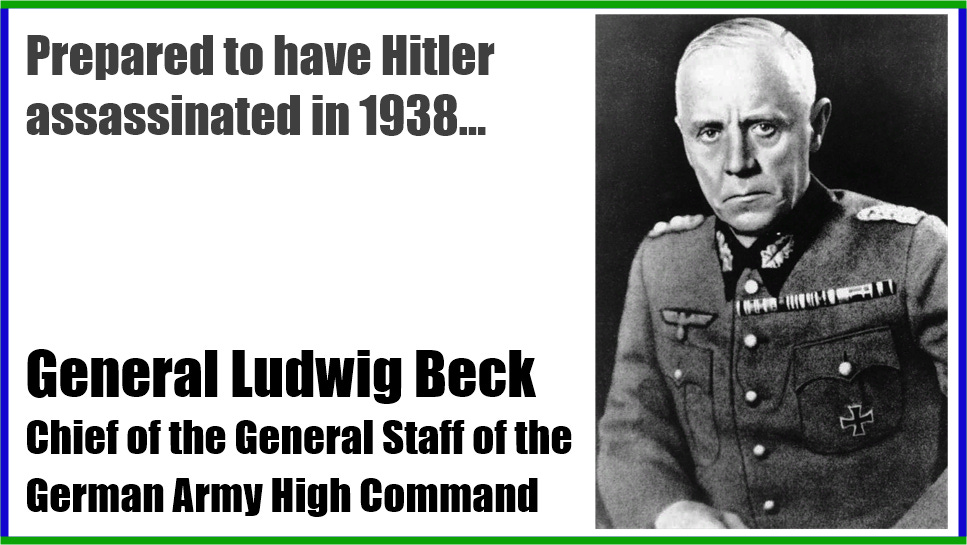
First, they would try to dissuade Hitler from pursuing them; second, they implored the British to stand firmly by Czechoslovakia and warn Hitler that Britain would oppose him. Third, if Hitler persisted in his resolve to wage war, they would proceed to assassinate him. The date for Hitler’s assassination was set for September 28, 1938. Please keep that date in mind as our story unfolds.
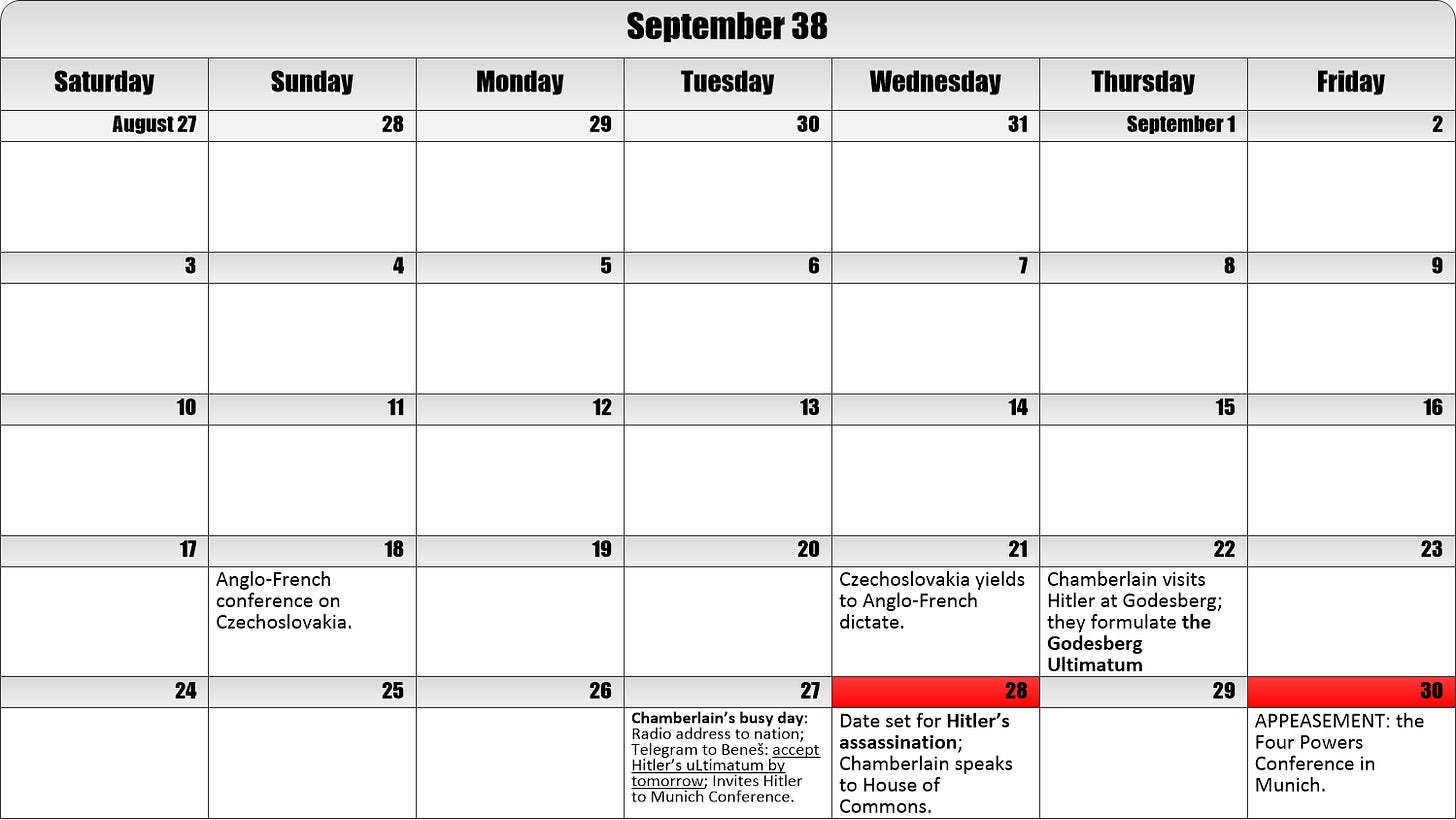
During the frenzied first two weeks of that month, message after message was communicated to London by Baron Ernst von Weizsacker (state secretary in Hitler’s Foreign Ministry), Erich Kordt (Joachim von Ribbentrop’s chief of staff) as well as a number of generals and various German missions in Europe. But not only did the British ignore all these pleas for help, they even took measures to shield Hitler from General Beck’s conspiracy. Chamberlain himself flew to Germany twice during the peak of the crisis (on the 15 and 22 September 1938) to broker an agreement that would enable Hitler to seize Czechoslovakia without waging war.
The role of British secret diplomacy
Britain’s covert foreign policy was run by a small group of men led by the Prime Minister Neville Chamberlain. It included Lord Halifax, Sir Horace Wilson, Sir John Simon, Lord Runciman and Sir Samuel Hoare.
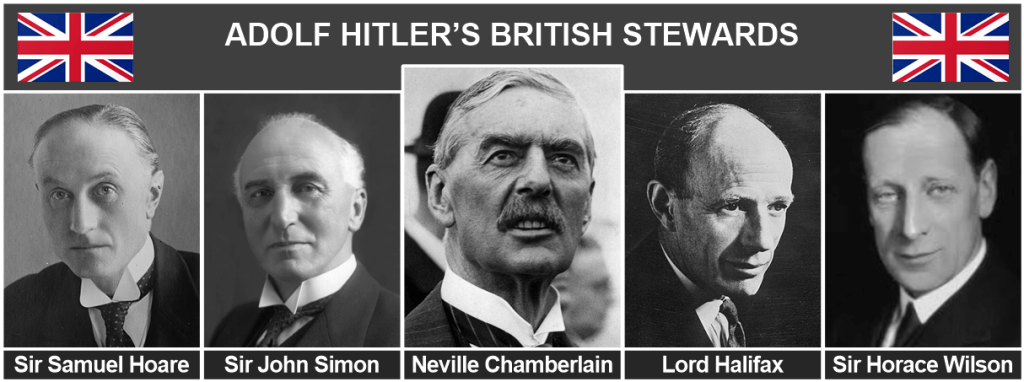
Their objective was to advance the three-block vision of the global order which entailed securing Germany’s hegemony over Central and Eastern Europe. The plan for Czechoslovakia was presented to the Czech ambassador in London by Lord Halifax on 25 May 1938. It included three key provisions:
-
Separation of the Sudetenland from Czechoslovakia
-
Neutralization of the rest of Czechoslovakia by revising her treaties with Russia and France
-
An international guarantee of this rump Czechoslovakia (though not by Britain).
That, in fact was the same arrangement that would ultimately be forced on the Czechs by the Four-Power Conference in Munich on 30th September 1938. For the British, it was essential to achieve these objectives without war. As Herbert von Dirksen, Germany’s ambassador to London wrote to Joachim von Ribbentrop on June 8, 1938, “Anything which can be got without a shot being fired can count upon the agreement of the British.” To facilitate this agenda, the British maneuvered Czech government to yield to all German demands without resistance.
Avoiding war was important for a number of reasons. First, the British wanted Germany to capture Czechoslovakia military assets and industrial facilities intact. Furthermore, they needed to preempt Russia and France from coming to their ally’s aid. Finally, they wanted to prevent a strong public outcry in Britain.
Shielding Hitler, keeping Czech allies away
Moscow’s efforts to intervene were consistently ignored and played down in public. Already in March of 1938, the Russians tried to form a united front against Hitler and proposed holding a security conference in Bucharest along with France, Britain, Poland and Romania, but their initiative was simply ignored.
The French position was neutered through the Anglo-French conference of September 18, 1938, where the British maneuvered the French to back their solution to the Czech crisis and to help pressure the Czechs to capitulate to German demands without a fight.
Inducing a war panic at home with fake news
The cabal in London also needed to sell all this to the British public which was viscerally opposed to Nazism. Accordingly, British officials and the media launched a propaganda campaign that gathered pace throughout the crisis. The opening salvo was launched with an article in Lord Rothmere’s Daily Mail, published on 6 May 1938. It denounced Czechoslovakia as an artificial monstrosity and an aberration of 1919. It also falsely accused the hateful Czechs of mistreating the German-speaking population, an outrage that Britain could not tolerate.
In addition to demonizing Czechoslovakia, the media also fomented a general war scare. Anxiety about the relentless German mobilization was built up day by day, convincing the public to believe the lie that Germany could easily overwhelm the Czechs in a few days and wipe out Prague.
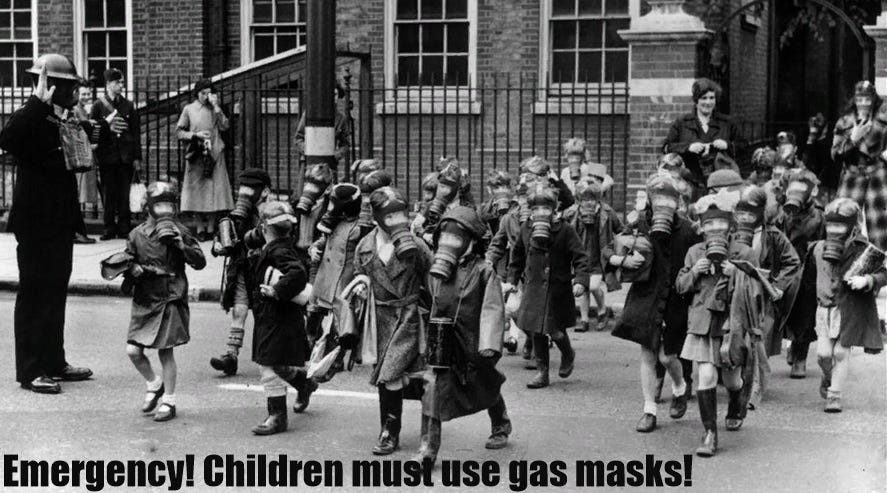
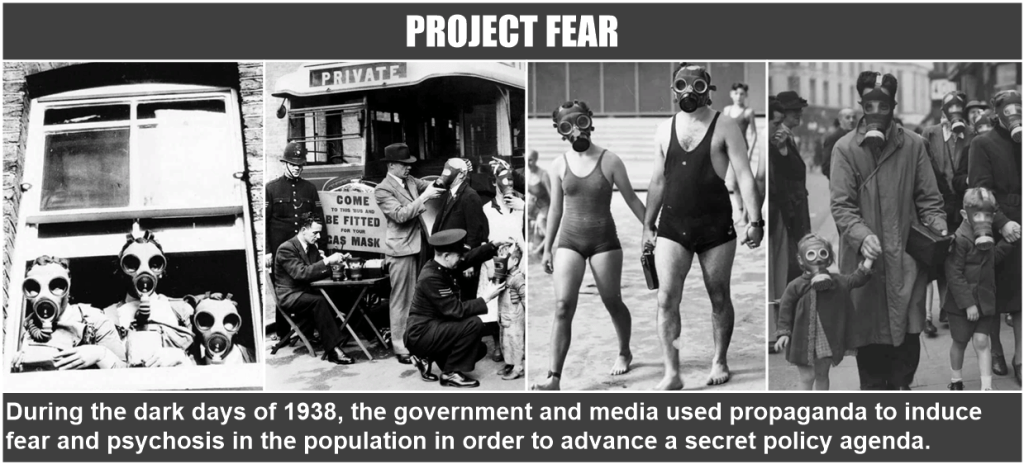
By late September 1938, the war psychosis was intensified to fever pitch with reports that German air force might imminently launch air raids against Paris and London and bomb the civilian population with poison gas ordnance. As panic set in, the British government escalated it by setting up stands where the people of London could be fit with Gas masks.
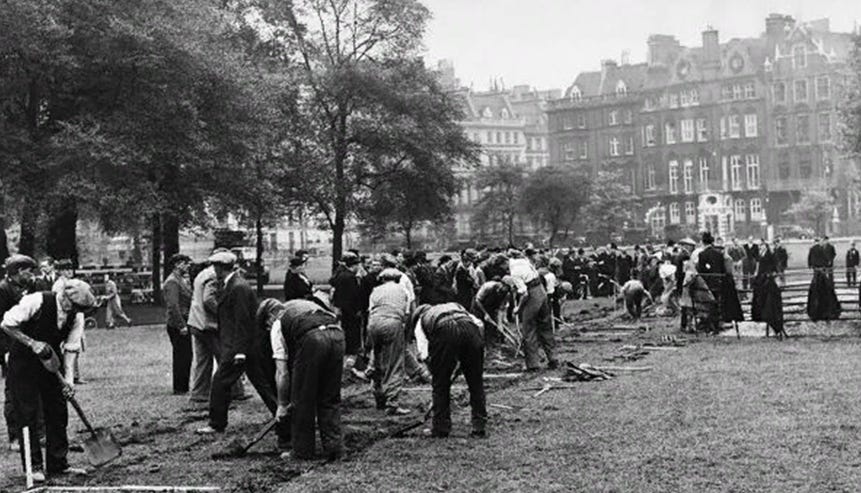
King George VI and Prime Minister Chamberlain called on the Britons to dig trenches in the parks and squares.
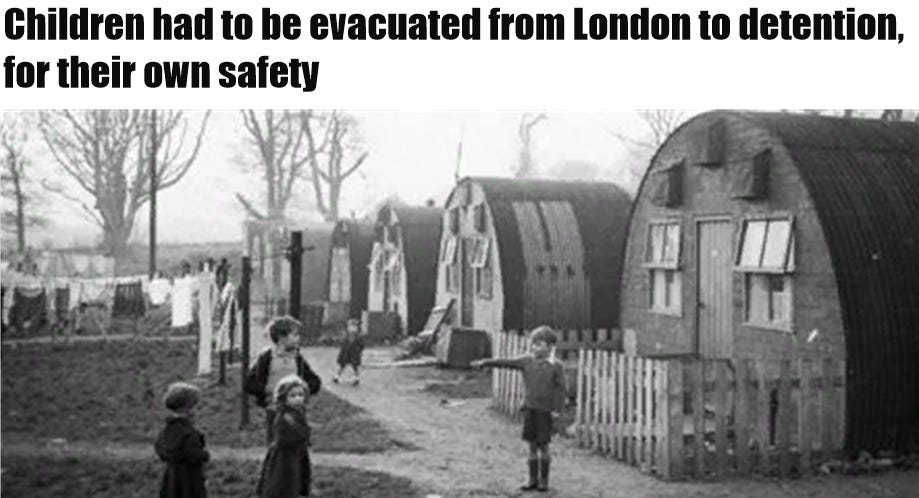
School children began to be evacuated to secure detention facilities away from London.
Every report or rumor that exacerbated the panic and defeatism was played up and any voice that encouraged taking a decisive stand against Germany was sidelined.
To be continued…
It gets a lot worse… In part 2 of this report, we’ll look at how Neville Chamberlain maneuvered Czechoslovakia’s government to commit suicide while performing extraordinary theatrics at home to deceive the British public and serve up Czechoslovakia, her military industry and arsenals to Hitler on a silver platter.